Villa Bonn, Neoclassical villa in Westend, Frankfurt, Germany
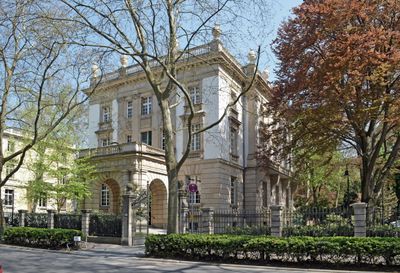
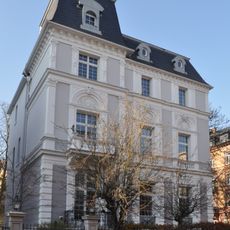
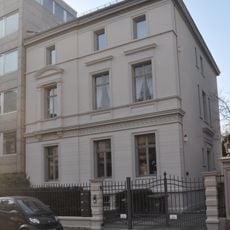
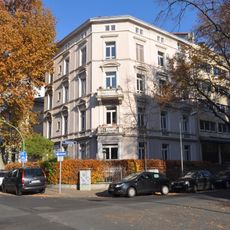
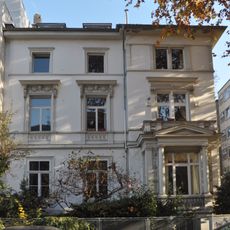
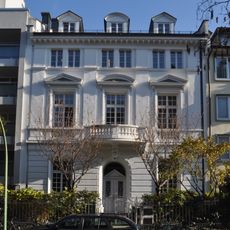
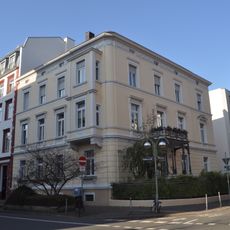
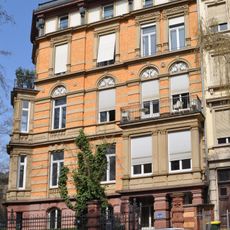
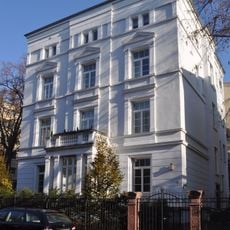
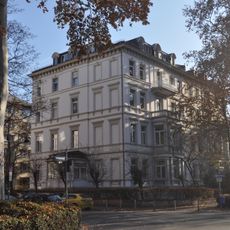
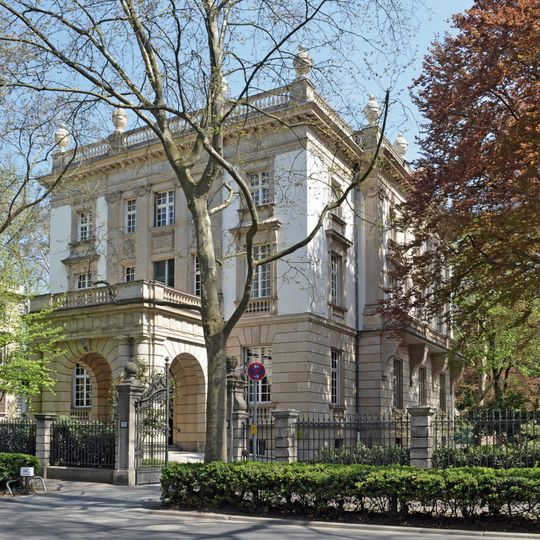
Villa Bonn is a three-story neoclassical palais built 1895–1897 on a park plot at Siesmayerstraße 12 in the Westend. Its cream stone facade has a rusticated banded base, a projecting entrance bay with a wide round arch, and a balustrade with stone urns along the bay and roof edge. Tall rectangular windows with white frames, some with shallow balconies and pediments, sit above a low stone wall with square pillars and iron railings.
Villa Bonn was built between 1895 and 1897 for the Frankfurt banker Wilhelm Bernhard Bonn, who died in Kronberg in 1910 and also owned the villa there that now serves as Kronberg's town hall. The Berlin court architect Ernst Eberhard von Ihne, later responsible for Schloss Friedrichshof in Kronberg, designed the three-story neoclassical building. In 1923 it passed to the Frankfurt Society for Commerce, Industry and Science, founded by Karl Kotzenberg and Georg Voigt, which made it a meeting place for German elites.
The villa's name comes from banker Wilhelm Bernhard Bonn, who had it built in 1895–1897; he also owned a villa of the same name in Kronberg, now that town's Rathaus. Since 1923 the house has belonged to the Frankfurter Gesellschaft für Handel, Industrie und Wissenschaft, founded by Karl Kotzenberg and Georg Voigt, and served as a meeting place for figures from commerce, industry, science and culture. The public can enter during the monthly concerts of the Robert-Schumann-Gesellschaft Frankfurt.
Villa Bonn stands at Siesmayerstraße 12 in the Westend, on a park plot; a low stone wall with square pillars and iron railings, with a hedge below, separates the front from the street. The building is not generally open to visitors: public access is possible during the monthly concerts of the Robert-Schumann-Gesellschaft Frankfurt.
After the Römer city hall was destroyed in World War II, Villa Bonn temporarily housed Frankfurt Mayor Walter Kolb and the municipal administration during reconstruction. This detail reveals how private buildings became essential for civic functions in the post-war period.
The community of curious travelers
AroundUs brings together thousands of curated places, local tips, and hidden gems, enriched daily by 95,037 contributors worldwide.