St. Georg Walldürn, Minor basilica in Walldürn, Germany
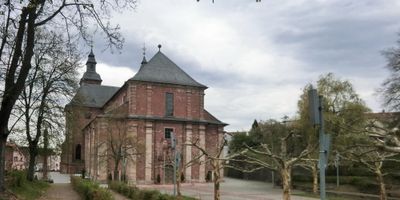
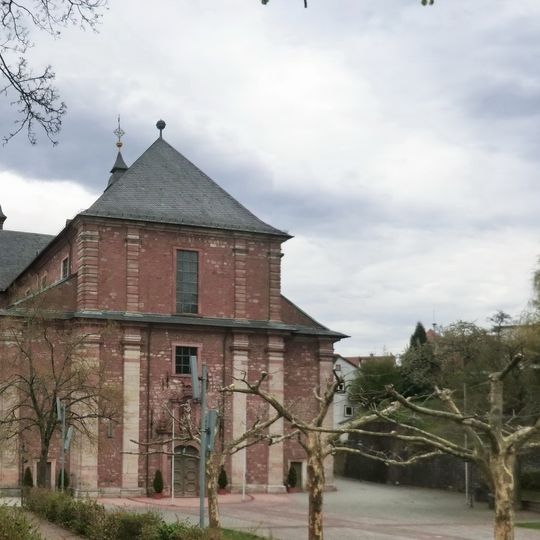
St. Georg Walldürn is a Baroque pilgrimage church built from 1698 to 1714, with furnishings completed by 1728. It is constructed of red sandstone with lighter stone pilasters dividing the walls, and has a transept and a three-sided choir flanked by two lantern-topped towers. The steep grey slate roof rises to a small dark spire with a cross. The lower storeys of the north tower survive from the medieval church, and the west portal, designed by Johannes Weydt in 1723, bears the coat of arms of Pope John XXIII.
The pilgrimage began around 1330, when, according to a 1598 account, the priest Heinrich Otto spilled consecrated wine on the corporal and an image of the crucified Christ appeared. Pope Eugene IV confirmed the miracle in 1445 and granted indulgences. The church was rebuilt from 1698 to 1714, with furnishings completed by 1728, and Pope John XXIII raised it to a minor basilica in 1962.
This church is the destination for one of Germany's largest blood processions, where pilgrims walk and move in processions around the sanctuary. This yearly devotion ties religious veneration to a tradition that still shapes how the town lives today.
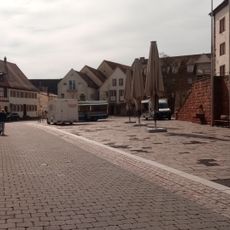
The church stands on a slope, so the eastern choir side, once the show facade, is best seen from below. The pilgrimage square west of the church, with its Lourdes grotto chapel, was laid out only after World War II. The chapel reopened in 2018 after a fire destroyed its interior in June 2017.
The altar holds a special relic under glass: the original cloth from 1330 with the mysterious stain considered a sign of holiness. This treasure is made visible to the public only on certain feast days and remains hidden from visitors otherwise.
The community of curious travelers
AroundUs brings together thousands of curated places, local tips, and hidden gems, enriched daily by 93,783 contributors worldwide.