Wallfahrtskirche Maria-Hilf, Catholic pilgrimage church in Vilsbiburg, Germany
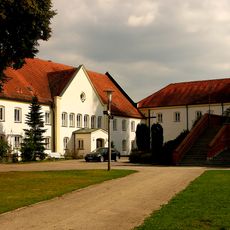
Wallfahrtskirche Maria-Hilf is a Neo-Romanesque wall-pillar church with an apse, built 1832–1836 to plans by Joseph Schlotthauer, a professor at the Royal Academy of Fine Arts in Munich, and consecrated on 14 August 1836. Two broad side aisles, a porch and two towers were added between 1877 and 1885 under pilgrimage director Ignaz Berger. It stands on a hill at the southern edge of Vilsbiburg and is also called the Bergkirche.
A chimney sweep named Donatus Barnabas Orelli built the first small chapel here in 1687 as an expression of personal devotion. Nearly 150 years later, this was replaced by the much larger Neo-Romanesque church that was constructed between 1832 and 1836.
The name Maria-Hilf refers to an image of Mary that believers have called upon for help across generations. The church draws visitors who come to pray and light candles, using the space to express their personal concerns.
The church sits on a hill south of the town center and is visible from various directions, making it easy to navigate to. It is generally accessible during daytime hours, though checking current opening times before visiting is wise since these can change based on events.
The church keeps a link to Rome: in 1872 the Redemptorist brother Max Schmalzl painted an icon in the vault of the former monastery's house chapel, copying the 14th-century icon that Pope Pius IX entrusted to the Redemptorists' church of Sant'Alfonso on Via Merulana in 1867. The image became known and loved around Vilsbiburg.
The community of curious travelers
AroundUs brings together thousands of curated places, local tips, and hidden gems, enriched daily by 94,647 contributors worldwide.