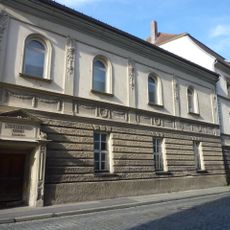
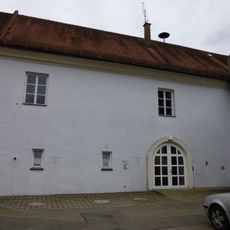
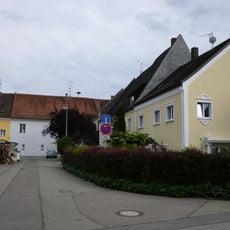
Wallfahrtskirche Mariä Himmelfahrt, Catholic pilgrimage church in Sossau, Straubing, Germany
Wallfahrtskirche Mariä Himmelfahrt is a single-nave pilgrimage church with a Romanesque core, a tall Gothic high choir added in 1350 under Abbot Friedrich of Windberg, and a nave raised at the same time while the tower kept its original height. Inside are frescoes by Joseph Anton Merz (1777), a high altar by Mathias Obermayr (1777), and a late-Baroque pulpit, side altars and organ gallery.
A predecessor church was documented in 1146; around 1140 Albert von Bogen gave Sossau to Windberg Abbey, where Abbot Gebhard had a new church built and consecrated in 1178. In 1350 Abbot Friedrich added a high Gothic choir and raised the nave, while the tower kept its earlier height. The single-nave interior was altered repeatedly into the 18th century.
The church's name comes from a legend that angels carried the building by boat across the Danube to Sossau; two framed panels in the nave depict this crossing. The Frauenglöckl, a 13th-century bell among the oldest in Straubing, is said to have been rung by the angels the morning after the journey.
The church is located in Straubing's Sossau district and welcomes visitors alongside worshippers. Inside, you can view the original organ and interior decorations at times when services are not taking place.
In 1736, excavations at the church walls found that the building has no foundation at all. Elector Karl Albrecht, emperor from 1742, took this as proof of the transport legend and celebrated the church as the "teutsches Loretho", a German Loreto.
The community of curious travelers
AroundUs brings together thousands of curated places, local tips, and hidden gems, enriched daily by 94,536 contributors worldwide.