Wandersmann, Cultural heritage monument in Wallau, Germany
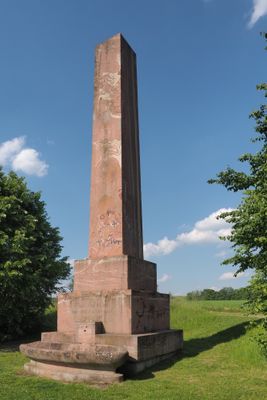
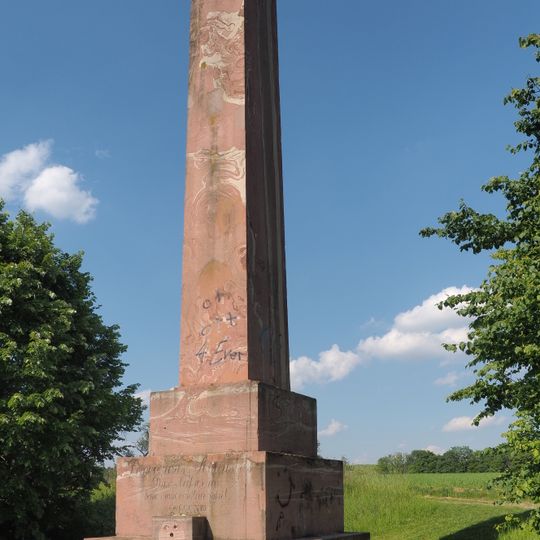
Wandersmann is a 20-tonne obelisk of red sandstone, eleven metres tall, standing on a three-tiered square base near the Wiesbaden motorway junction. Its Latin inscription records that Duke Friedrich August of Nassau ordered the road built in 1813. A stone basin at its foot once served as a watering trough for horses.
The obelisk was built between 1816 and 1819 south of the new chaussee on the roughly 160-metre ridge between the Wickerbach and Weilbach, the highest point of the Wiesbaden–Frankfurt route. It recalled the road-building programme begun after the Duchy of Nassau was founded in 1806. In 1935 it was moved for the Wiesbaden motorway junction, and in 1982 it was relocated again, 60 metres from the north-western part of the junction, after a dispute between the road administration and the lower heritage authority.
The name comes from the inn Zum Wandersmann, opened before 1819 in a construction hut near Wallau and given that name in 1850. The road then took the name Wandersmannstraße, still visible in Erbenheim, and the obelisk became the Wandersmann-Denkmal. The inn was demolished in 1958 for the Frankfurter Straße expansion.
The obelisk stands at the end of the slip road linking the A 3 from Cologne to the A 66 towards Wiesbaden, 60 metres from the north-western arm of the Wiesbaden cross interchange. It is not a walkable public square: it can only be seen from the motorway or from the adjoining roads, so plan a stop by car rather than on foot.
The obelisk's name comes not from the monument but from a tavern: the inn built in the former construction hut near Wallau took the name Zum Wandersmann in 1850, and the road and obelisk were renamed after it. The tavern was demolished in 1958 for the Frankfurter Straße expansion.
The community of curious travelers
AroundUs brings together thousands of curated places, local tips, and hidden gems, enriched daily by 93,830 contributors worldwide.