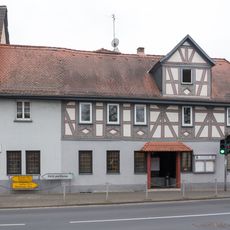
Natural monuments in Büdingen/440.004 Wilder Stein, Natural monument near Steinhaus Hotel in Büdingen, Germany.
Wilder Stein is a columnar basalt outcrop rising above Büdingen, formed as a volcanic vent linked to the Vogelsberg volcanism about 15–18 million years ago. Its dark, dense basalt shows the five- to six-sided columns known as Meilerstellung, indicating a former lava lake. Yellowish-white layers with bluish-grey deposits mark where sandstone was pulled into the hot vent and baked, and some of it hardened into columns between the basalt.
The basalt columns formed 15–18 million years ago, when magma from the Vogelsberg volcanic field rose through older Zechstein, Buckelschiefer and Buntsandstein layers. The heat baked the sandstone into a yellowish rock that August von Klipstein named Buchit, with the Wilder Stein as its type locality. In 2010 the Vogelsberg section of the German Volcanological Society named it Geotope of the Year.
The name shortens "der wilden Frau Gestein", the rock of the wild woman, and pre-Christian use as a cult site is claimed. In the witch trials of the 16th and 17th centuries, accused women confessed under torture to riding to the Wilder Stein with the devil. The geologist August von Klipstein named the baked sandstone Buchit after the site, its type locality.
The site is accessible on foot and located near the Muhltor bus stop in Büdingen. Visitors can reach the formation from nearby roads and explore the area throughout the year.
Scientists use the site as a study location to examine rock formations in the region. The formation offers insights into the geological makeup of central Germany.
The community of curious travelers
AroundUs brings together thousands of curated places, local tips, and hidden gems, enriched daily by 94,952 contributors worldwide.