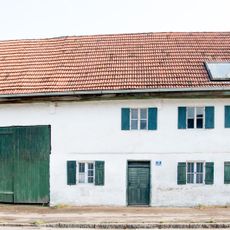
Schloss Oberlauterbach, Medieval water castle in Pfeffenhausen, Germany
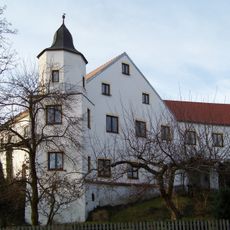
Schloss Oberlauterbach is a medieval water castle in Pfeffenhausen featuring a four-story brick structure with octagonal dome towers positioned at each corner. The buildings sit in an irregular arrangement around a central courtyard lined with arcades.
Ritter Ebran von Wildenberg built the water castle in 1272. In 1392 the Leutenpeckh von Lauterbach, a family from Leitenbach an der Abens, took over the fortified house and held it until 1527, when it passed to the Puschen after the death of Leonhard, the last Leuthenpeckh. In 1632, during the Swedish War, Duke Bernhard of Saxe-Weimar destroyed part of the castle; Count Max von Portia rebuilt it in 1663. The von Cetto family has owned it since 1845.
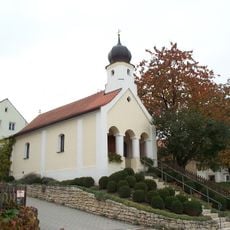
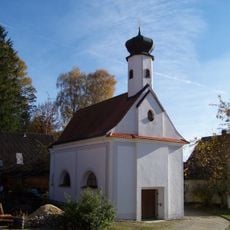
The castle's name comes from the Lauterbach stream beside it, a tributary of the Großen Laber. The plague that followed the Swedish War of 1632 left only one survivor in the area, and the Pestkapelle still commemorates it. The chapel by the north-wing entrance dates from around 1740.
The castle stands in the centre of Oberlauterbach directly on the Lauterbach stream, a tributary of the Große Laber, so it is reached on foot from the village rather than through a park. The four-storey brick building encloses a single arcaded courtyard; the entrance is in the north wing, where the house chapel of around 1740 stands beside the door and the former stables lie to the north. The whole complex, outbuildings and castle garden included, is protected as a monument.
The castle's brick walls enclose an arcade courtyard, and the north wing holds a house chapel from around 1740 beside the entrance. The site is recorded as a Bodendenkmal, D-2-7237-0219, for medieval and early modern remains beneath the grounds, including traces of earlier buildings and demolished wings.
The community of curious travelers
AroundUs brings together thousands of curated places, local tips, and hidden gems, enriched daily by 93,377 contributors worldwide.