Wasserturm Mönchengladbach, Art Nouveau water tower in Mönchengladbach, Germany.
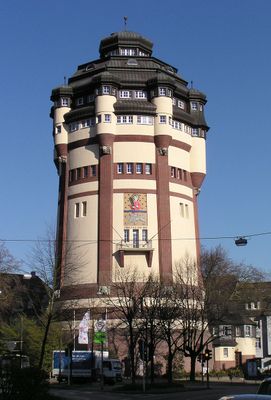
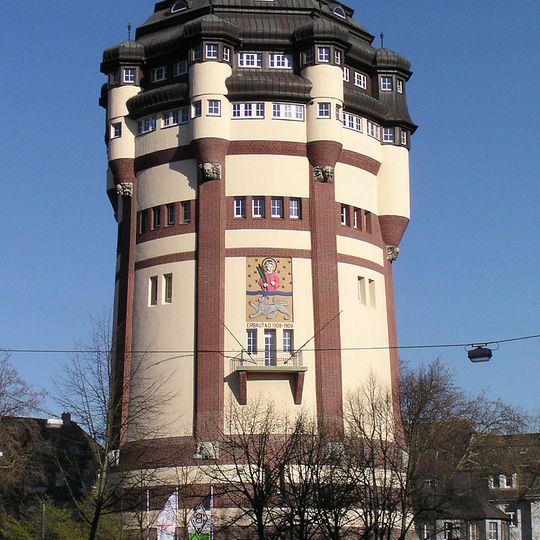
Wasserturm Mönchengladbach is a 51-metre water tower built of brick with dark-red Gladbach hand-moulded facing bricks, completed in 1909 to designs by Otto Greiß. Its octagonal head carries six small turrets with simply curved hoods around a multi-curved copper roof topped by a five-metre octagonal lantern. The upper sculpture ring shows stone faces by Emil Hollweg, while the lower ring depicts water animals such as fish and crabs.
The tower was built between 1907 and 1909 to plans by city architect Otto Greiß and inaugurated on 14 November 1909. It was one of six water towers the city erected before World War I to keep pace with its rapid growth. Greiß intended it as a landmark as well as a water supply; construction cost 212,000 marks. It survived World War II without damage.
The tower shows how the city around 1900 modernized its infrastructure while still caring about artistic details. This mix of practical need and designed beauty still shapes the cityscape today.
You can see the tower's architectural details from several points along the surrounding streets, and daylight offers the best viewing conditions. The surrounding public areas are freely accessible for photos and exploration.
The stone sculptures on the upper ring were carved by Mönchengladbach sculptor Emil Hollweg and portray mayor Hermann Piecq and members of his family; a son of Piecq appears in the city coat of arms above the balcony as Saint Vitus. The lower ring shows water animals such as fish and crabs.
The community of curious travelers
AroundUs brings together thousands of curated places, local tips, and hidden gems, enriched daily by 93,836 contributors worldwide.