Schloss Willingshausen, Renaissance castle in Willingshausen, Germany
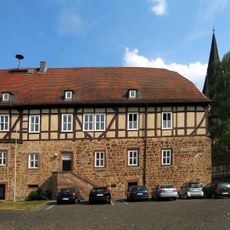
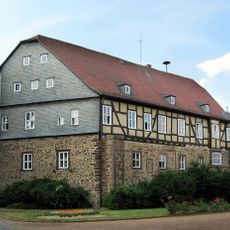
Schloss Willingshausen, also called Schwertzellsches Schloss, is a three-storey Baroque manor house on a massive cellar base, measuring about 23 by 14.5 metres, with two attic levels under a hipped-gable roof. A round stair tower projects half its width from the west facade, and a two-storey Renaissance bay window sits at the south-west corner, bearing four stone coats of arms and the inscription "IST REPARIERT DES JAHRS MDCXCVIII".
The Schwertzell family acquired jurisdiction over Willingshausen in 1489 and built the present castle in the 16th century as their new seat, replacing an earlier small castle in today's park. A coat of arms stone on the stair tower is dated 1496. The castle was partially destroyed and plundered in the Thirty Years' War, renewed in 1698 with a timber-framed upper storey added for more living space, and its inventory was plundered again in the Seven Years' War.
The castle's name Schwertzellsches Schloss refers to the von Schwertzell family, who still run the estate's farm administration from the building. Wilhelmine von Schwertzell collected fairy tales from the Schwalm for the Brothers Grimm and kept up a lively correspondence with them; Wilhelm Grimm, a friend of the family from 1810, regularly stopped at the castle on journeys between Kassel and Marburg.
The castle sits on the edge of the village and is easy to view from outside, featuring a central hall connected to the staircase tower. Visitors can observe the interior layout and architectural details of this historic structure.
In 1824, the castle became the founding place of an artist colony when painter Gerhardt Wilhelm von Reutern came to recover from battle wounds. His presence attracted other artists and transformed the location into a center for painting.
The community of curious travelers
AroundUs brings together thousands of curated places, local tips, and hidden gems, enriched daily by 93,782 contributors worldwide.