Cerkiew św. św. Konstantyna i Heleny w Berlinie, Eastern Orthodox church in Tegel, Germany
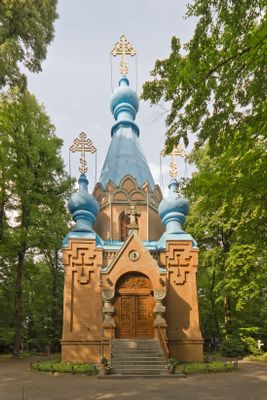
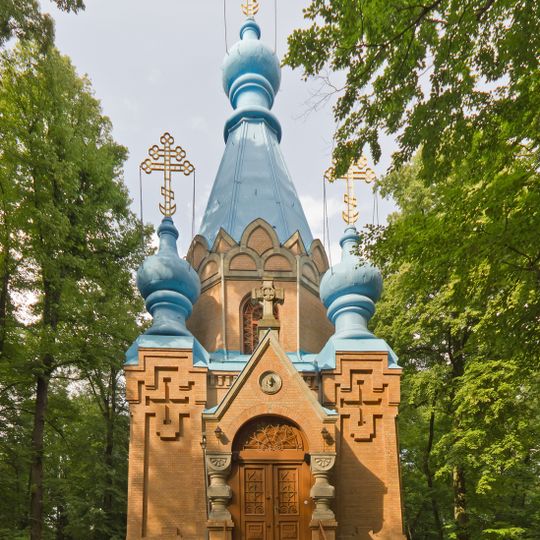
St. Konstantin und Helena Church is a square-planned brick church on the Russian cemetery in Berlin-Tegel, built in the Byzantine-Muscovite style. Five blue-painted onion domes with gold crosses rise above tan and reddish-brown brickwork; the central dome sits on a tall light-blue conical spire. The lower façade has a pointed gable over a wooden double door with a fan-shaped window, and recessed brick cross patterns decorate the walls.
In 1892 the Orthodox St. Vladimir Brotherhood and Archpriest Alexei Maltsev, rector of Berlin's embassy church, bought two plots in the then-suburban village of Tegel, one for a cemetery and one for a charitable Brotherhood house. The church was laid in 1893 to a design sent from Russia and built under the local architect Bohm; it was consecrated a year later. Badly damaged in the war, it was repaired only in the 1980s and 1990s with Berlin city funding.
The church was consecrated for the Greek, Serbian and Romanian communities as well, which had no churches of their own and worshipped at the Russian embassy church. Its gilded carved-oak iconostasis was donated by Alexander Grigoryevich Eliseyev, and icons came from the Synod and Mount Athos. Since the 1980s it has served as a parish church for about 200 faithful of various nationalities.
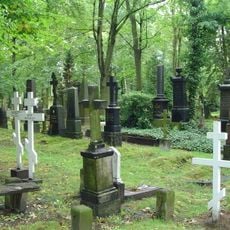
The church stands in the centre of the Russian cemetery in Berlin-Tegel, in the Reinickendorf district, and is reached on foot from the cemetery entrance; a bell tower with five bells rises above the main gate. The building was meant for funerals and holds only about 30 to 40 people, so space inside is limited. The grounds were badly damaged after the war, when the church lost its doors, window frames and glass and the more than 300-metre boundary wall was hit.
By order of Alexander III, four tonnes of soil gathered from twenty Russian governorates were brought to Tegel and scattered across the cemetery grounds. Lime, oak and maple saplings arrived from Russia as well, so the dead abroad would rest in native earth beneath Russian trees.
The community of curious travelers
AroundUs brings together thousands of curated places, local tips, and hidden gems, enriched daily by 92,808 contributors worldwide.