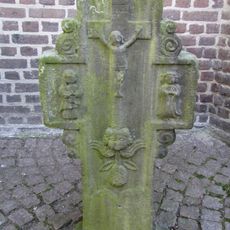
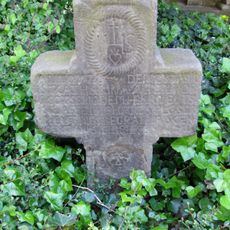
St. Andreas, Parish church in Korschenbroich, Germany.
St. Andreas is a brick Neo-Gothic pseudo-basilica in Korschenbroich, consecrated in 1892. Its 46-metre tower, built in 1504, survives from the late-Gothic church demolished in 1888 and is the town's oldest standing structure, with tuff and brick up to the middle of the second storey and brick above. The interior centres on an octagonal altar island from the 1982 renovation.
A church existed here around 1000, built with Roman bricks, Brohler tuff and Liedberg sandstone. The late Gothic hall church of 1471 was demolished in 1888; only the 46-metre tower of 1504 survived and was incorporated into the new Neo-Gothic brick church begun in 1890 and consecrated in 1892. The nave was destroyed in the bombing night of 22–23 August 1943 and rebuilt from 1947 to 1949.
The parish patron is the Apostle Andrew; six apostle portraits on the west wall, including Andrew, Peter and James the Elder, were made by Italian artist Viktor Seroner in 2001/2002. A Baroque altar lost for 125 years was rediscovered and reinstalled in 1998 at the apex of the choir; it had served for Corpus Christi processions. The former church square was renamed Pfarrer-Müller-Platz in honour of pastor Alois Müller (1974–2005).
The church is best reached on foot from Korschenbroich's town center, where it serves as a recognizable landmark for orientation. Visiting on a quiet weekday is advisable if you prefer fewer crowds and a calmer experience.
The 46-metre tower, built in 1504, is the oldest surviving structure in Korschenbroich and was retained when the 1471 church was demolished in 1888. Its lower section is tuff and brick, its upper part brick alone. A tower was not required for worship but financed by the parish to display its wealth, suggesting a prosperous congregation.
The community of curious travelers
AroundUs brings together thousands of curated places, local tips, and hidden gems, enriched daily by 93,728 contributors worldwide.