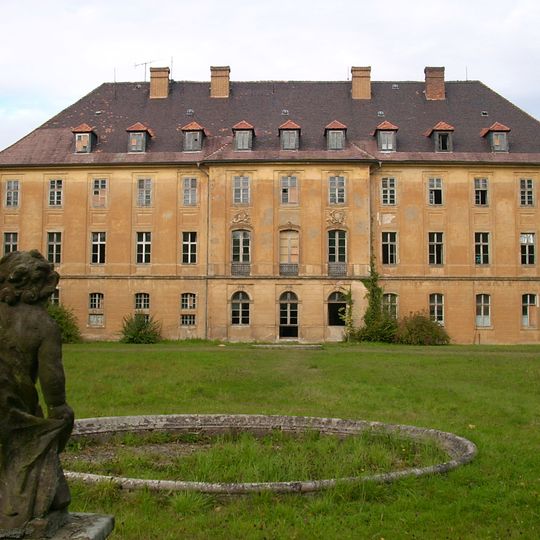
Uhyst Castle, Cultural heritage monument in Boxberg, Germany
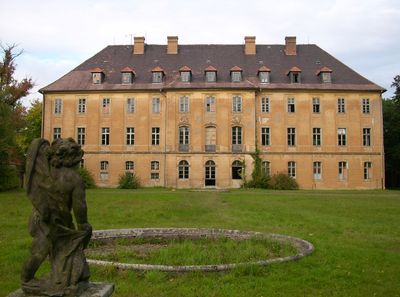
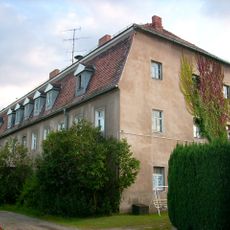
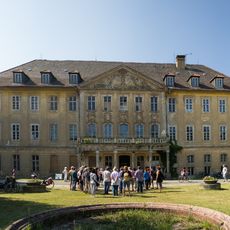
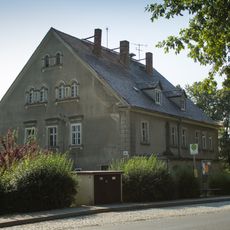
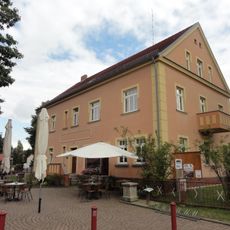
Uhyst Castle is a three-storey building on a rectangular plan, about 48.5 metres long, 18.5 metres wide and 13.5 metres high to the eaves, with an elevated base floor and a hipped roof. Originally Baroque, it was remodelled in neoclassical style in the 19th century. Its entrance front is crowned by a central avant-corps with a sandstone gable of heavy rolling leaf ornamentation, a colonnade and a balcony.
Friedrich Caspar Graf von Gersdorff, who became feudal lord in 1725, had the New Castle built from 1738 to 1742 because the Old Castle was too small; the plans came from an Italian architect, possibly Johann Christoph Knöffel. In 1745 a Sorbian seminary for preachers and teachers, founded in 1730 at Klix, moved in temporarily with its school. The Old Castle was demolished in 1836, and the building later passed to the Kluge family before the SS seized it during the Second World War.
The park's core is a French formal garden laid out for Friedrich Caspar Graf von Gersdorff, with two circular sandstone fountain basins on the central lawn axis and a putto with harp flanked by Apollo and Artemis. Four sandstone sculptures, brought from the Mönau castle park around 1879 by Baron von Rabenau, stand in the baroque garden; Ceres marks the eastern path. A branch of the Spree feeds the smaller pond, and the larger Schwanenteich holds an island.
The castle park is open to visitors and can be explored on foot without any special preparation. Those interested in seeing inside the building should check in advance, as interior access is not always available.
For four decades, from 1952 to 1992, the building was used as a medical sanatorium, a function very different from its origins as a noble residence. Some traces of that period can still be noticed in parts of the building if you look closely.
The community of curious travelers
AroundUs brings together thousands of curated places, local tips, and hidden gems, enriched daily by 94,191 contributors worldwide.