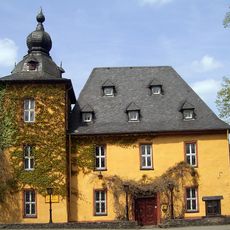
Zwergenhöhle, Cave and archaeological site in Odenthal, Germany.
The Zwergenhöhle is a karst cave cut open by quarrying in the Paffrather Kalkmulde, on the road from Herrenstrunden to Spitze in the Strundetal, Odenthal. Its rock is Middle Devonian reef limestone formed about 380 million years ago in a tropical shallow sea; later carbonate dissolution under subtropical Tertiary conditions widened fissures into cave passages.
The cave lies in Middle Devonian reef limestone that formed about 380 million years ago in a tropical shallow sea. During the Tertiary, the sinking of the Lower Rhine Basin and subtropical weathering dissolved the carbonate rock, widening fissures into cave passages. Quarrying later cut into the cave, and it is now registered as natural monument OD_2.3-09 in Odenthal.
In the Bergisch dialect the cave is called Quergskuhl, roughly 'dwarf hollow'. Otto Schell recorded a legend titled Die Quergskuhl bei Herrenstrunden in his collection, which tells of the small figures associated with the hollow. The name and the tale are how the quarry-cut cave is known locally.
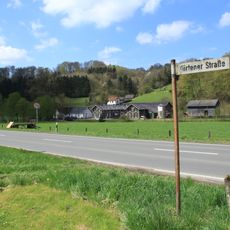
The cave is permanently sealed so that bats can hibernate undisturbed; Brown long-eared, greater mouse-eared and water bats have been found wintering inside. There is no entry, so visitors only see the quarry-cut rock face from the road between Herrenstrunden and Spitze. The site is listed as natural monument OD_2.3-09 in the Südkreis landscape plan.
The cave is listed as natural monument OD_2.3-09 in the "Südkreis" landscape plan of the Rheinisch-Bergisch district. In the Bergisch dialect it is called Quergskuhl, roughly "dwarf hollow". Otto Schell recorded a legend titled Die Quergskuhl bei Herrenstrunden.
The community of curious travelers
AroundUs brings together thousands of curated places, local tips, and hidden gems, enriched daily by 94,476 contributors worldwide.