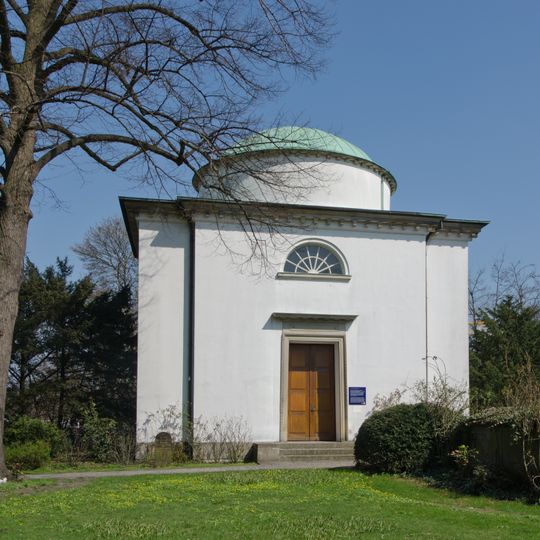
Schimmelmann-Mausoleum, Neoclassical mausoleum in Wandsbek, Germany
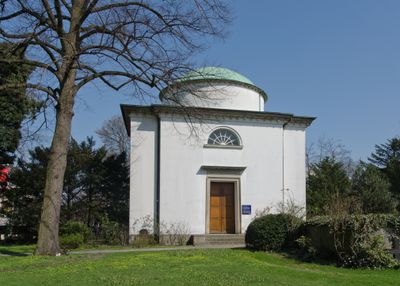
The Schimmelmann Mausoleum is a domed classical tomb near the Christuskirche in Hamburg-Wandsbek. Its plain exterior shelters a domed hall carried by four Doric columns, with two half-domes to the north and south and a round window on each of the east and west sides. The two sarcophagi of dark, yellow-veined Carrara marble stand in the side niches, and the floor is a mosaic of coloured stones forming a central rosette.
Schimmelmann died in Copenhagen in 1782 and was first buried in the St. Petrikirche there; his remains were moved to Wandsbek in 1785. The mausoleum was built from 1787 to 1791 to designs by Carl Gottlob Horn, simplified at the heirs' request, and Schimmelmann was interred in it in 1792, ten years after his death. His wife Caroline was buried there in 1795.
The mausoleum became a war memorial in 1923 on the suggestion of Wandsbek pastor Boie: the sarcophagi were sunk into a shallow vault about a metre below the floor and twenty panels bearing 1,000 names were fixed to the walls. It was inaugurated for the 300th anniversary of the parish.
The mausoleum stands near the Christuskirche in Hamburg-Wandsbek. Its entrance was moved from the west to the east side in 1896. In 1923 the sarcophagi were sunk about a metre below the floor into a shallow vault, and twenty wall tablets listing 1,000 names were added.
The marble sarcophagi arrived by ship from the Italian quarries in 1790, transported all the way to Hamburg harbor. This costly effort to bring such materials reveals how much importance the family placed on the quality of the tomb's contents.
The community of curious travelers
AroundUs brings together thousands of curated places, local tips, and hidden gems, enriched daily by 93,248 contributors worldwide.