Fußgängerplattform am Selterstor, Pedestrian bridge in Giessen, Germany
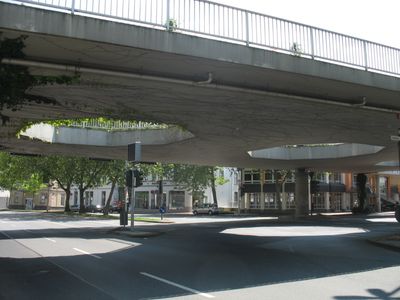
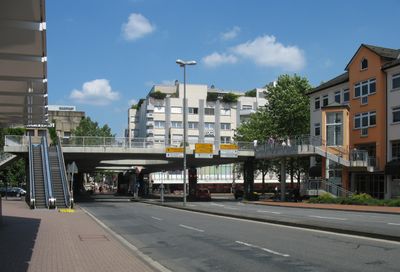
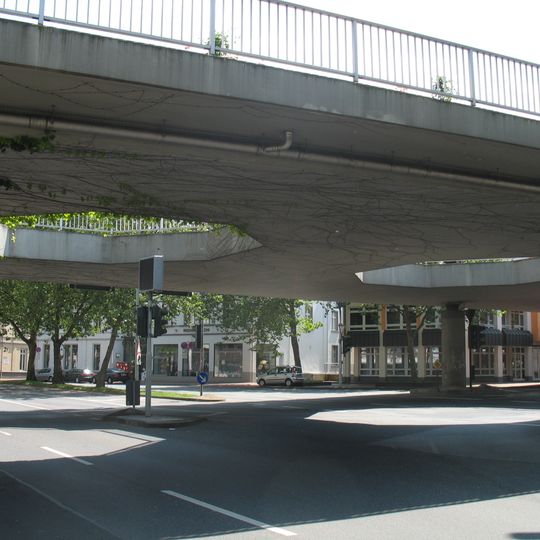
The Fußgängerplattform am Selterstor, known as the Elefantenklo, is a trapezoidal prestressed lightweight-concrete platform about 50 metres long and 24 metres wide, held up by six columns. Three octagonal openings 7 to 9 metres wide run along its centre line, letting daylight down to the traffic and giving walkers a view of the road. Stairs, escalators and a lift added later at the south corner reach the deck, whose pale parapet carries a metal railing.
The platform opened in 1968 when city planners prioritized keeping cars and pedestrians separate in busy urban centers. It replaced an earlier intersection arrangement and became a symbol of how cities were reshaping themselves around vehicular traffic during that period.
The nickname Elefantenklo, or "E-Klo" for short, arose from the structure's oversized scale and its three large openings, which resemble an oversized toilet. The student group Akademischer Micky Maus Club is credited as the original inventor of the name; for the 40th anniversary in 2008 its members unveiled a banner reading "Elefantenklo". The left-wing city magazine Elephantenklo, published from 1977 to 1987, adopted the name.
The platform is reached by stairs and escalators at its four corners; a lift was added later at the south corner. The only step-free link to the Seltersweg pedestrian zone runs through the Karstadt department store and works only during its opening hours. Escalators and lifts have a record of breaking down, so allow extra time.
The water curtain was added in 2014 for the Landesgartenschau at a cost of about 150,000 euros, funded by the local traders' association as a "flush" for the structure. Water falls from the platform into a concrete basin 4.60 by 2.80 metres wide and two metres deep, sunk into the ground.
The community of curious travelers
AroundUs brings together thousands of curated places, local tips, and hidden gems, enriched daily by 92,712 contributors worldwide.