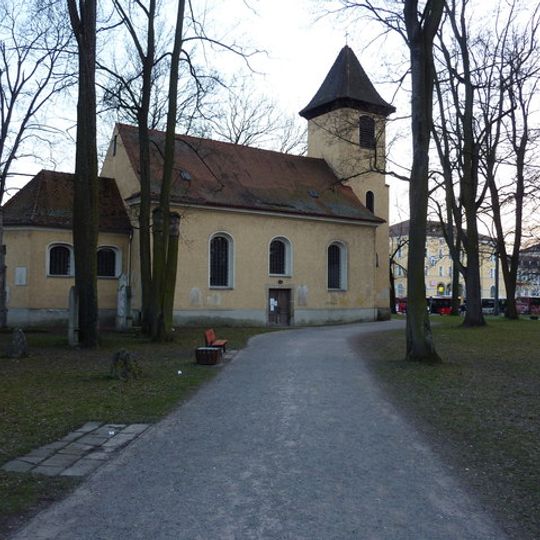
St.Peter, Neoclassical church in Regensburg, Germany.
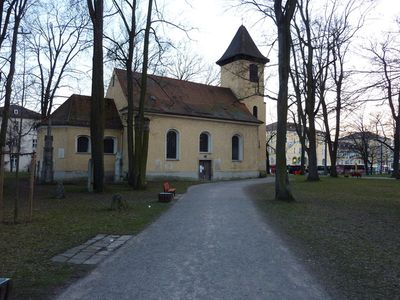
St. Peter in Regensburg is a small Neoclassical hall church with a three-bay nave, a recessed choir, and a west tower under a steep dark pyramidal roof. The walls are pale yellow with brown-tiled roofs; round-arched windows with dark glass and light stone trim line the nave and the lower side projection, and a dark door sits centrally below. Two memorial plaques are mounted on the west facade.
Georg Michael Wittmann had a chapel built here in 1806 to plans by Emanuel Herigoyen, as the cemetery church of the new Catholic cemetery outside the walls. Only the choir survives from that chapel: the nave and west tower were completed in 1821, eleven years after Regensburg passed to the Kingdom of Bavaria. Felicitas von Neuenstein, last princess-abbess of Obermünster, paid much of the cost. The Catholic cemetery was given up in 1888–1892 for the new main station.
The church remains an active center for worship and religious celebrations in the city, where visitors can observe how the community gathers for services and seasonal ceremonies. The space reflects the deep connection between Regensburg's residents and their faith traditions across different times of the year.
The church is open to visitors but remains an active place of worship, so visiting during service hours should be avoided for a proper visit. Guided tours can provide insights into the building's design and history, though it is best to check in advance about availability and timing.
On the west facade, two memorial plaques face each other: the upper one commemorates Bishop Georg Michael Wittmann, whose heart is buried here, while a second plaque honours Johannes Kepler. Kepler was buried in the former Protestant Petersfriedhof, but his grave was destroyed in 1633 and its location lost. The plaque was donated in 1994 by the Johannes Kepler University Linz.
The community of curious travelers
AroundUs brings together thousands of curated places, local tips, and hidden gems, enriched daily by 93,590 contributors worldwide.