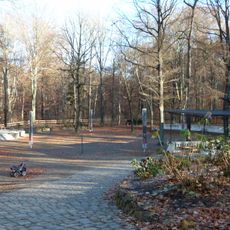
Chinese Pavilion, Weißer Hirsch, Pavilion in Weisser Hirsch district, Dresden, Germany.
The Chinese Pavilion at Bautzner Landstraße 17a in Dresden is a classic Chinese timber hall built in 1911 for the International Hygiene Exhibition. It combines a five-bay southern Chinese hall with a surrounding gallery and a curved northern Chinese hip roof with a rounded ridge. A half-octagon annex with a helmet-shaped roof adjoins the south side, and the originally single-storey structure was later raised on a basement.
The Chinese Pavilion was built for the First International Hygiene Exhibition in Dresden in 1911 as the exhibition pavilion of the Chinese Empire, commissioned by its imperial government. Carpenters from Shanghai erected the traditional hall structure in China, then it was dismantled, shipped to Dresden and reassembled by local workers. After the exhibition the Chinese government left it in Dresden as a gift; in November 1911 the municipality of Weißer Hirsch bought it for 8,500 marks and, under architect Max Müller, re-erected it in the town hall garden on a new basement storey. Reopened on 1 August 1912 as a reading café, it later housed a milk cure hall, a restaurant and, in 1992, Dresden's first Chinese restaurant; after a fire in 1997 it was restored from 2007 and reopened on 1 October 2015 as a venue for German-Chinese exchange.
The pavilion was a gift from the Chinese imperial government after the 1911 International Hygiene Exhibition, and from 1912 it served as a reading café stocked with domestic and foreign newspapers and magazines. It later housed a milk-drinking cure hall run by Pfunds Molkerei, and in 1992 Dresden's first Chinese restaurant opened here. Since 2015 it has been a meeting place for German-Chinese exchange.
The pavilion is open from May through September and offers group tours for those interested in architecture. Visitors should check conditions ahead of time, as access can vary depending on season and weather.
The pavilion was first built in China by carpenters from Shanghai, then dismantled, shipped to Dresden and reassembled by local workers for the 1911 International Hygiene Exhibition. A three-storey pagoda stood beside it on the exhibition grounds; nothing of it survives. The Chinese government left the hall and its furnishings in Dresden as a gift, and in November 1911 the municipality of Weißer Hirsch bought it for 8,500 marks.
The community of curious travelers
AroundUs brings together thousands of curated places, local tips, and hidden gems, enriched daily by 92,621 contributors worldwide.