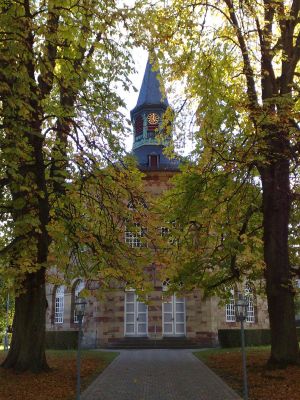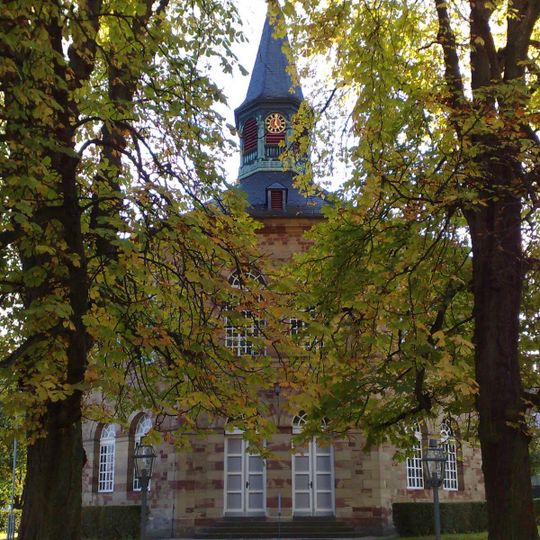
Evangelische Kirche, Protestant church in Bischmisheim, Germany.
The Evangelische Kirche Bischmisheim, also called Schinkelkirche, is an octagonal church of 1823–1824 built in local Buntsandstein with a slate roof, standing at Kirchstraße 1. Its plan by Karl Friedrich Schinkel departs from the usual rectangular village churches of the Saarland; Johann Adam Knipper the Younger carried out the design and contributed the altar and pulpit.
The medieval predecessor church, first documented in 1332, was so dilapidated that it was closed by police in 1813. In 1821 Karl Friedrich Schinkel rejected Johann Adam Knipper's design and drew an octagonal plan; the church was built between 1823 and 1824 and consecrated on 3 August 1824, the Prussian king's birthday. Knipper adapted the plans, using local Buntsandstein and a slate roof.
The church is also called Schinkelkirche after its designer Karl Friedrich Schinkel, who drew the octagonal plan in 1821. The foundation stone was laid in 1823 and the consecration took place on 3 August 1824, the birthday of King Frederick William III of Prussia. The altar and pulpit were designed by Johann Adam Knipper the Younger.
The building is easily accessible from outside and displays its architectural features clearly from the street. Visitors can view the exterior facade at any time, though interior access is typically limited to regular worship services.
Schinkel designed numerous church buildings in similar style, but this version demonstrates his particular approach to adapting Greek revival principles for Protestant worship. The application of classical forms to a contemporary religious program offers insight into how historical styles were reinterpreted during this era.
The community of curious travelers
AroundUs brings together thousands of curated places, local tips, and hidden gems, enriched daily by 92,905 contributors worldwide.