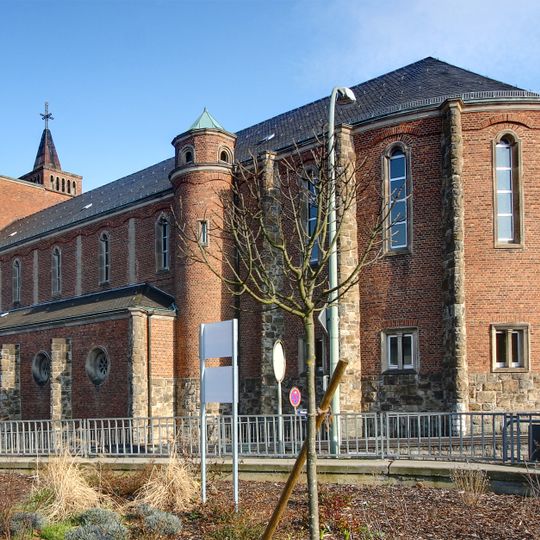
St. Marien, Expressionist monastery church in Limburg an der Lahn, Germany
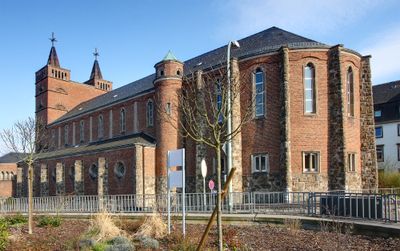
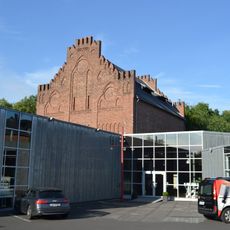
St. Marien is a Catholic monastery church built in Expressionist style between 1925 and 1927 to plans by Jan Hubert Pinand, who was influenced by Dominikus Böhm. The red brick facade has tall narrow arched windows and lower round windows with stone surrounds, while the lower walls are of rough irregular stone blocks. A square tower with a steep pointed spire topped by a cross stands beside a round turret with a conical roof; the central opening in the tower is divided into windows below and a bell opening above.
St. Marien was built between 1925 and 1927 in Expressionist style to plans by Jan Hubert Pinand, who was influenced by Dominikus Böhm; the Pallottines contributed considerable labour of their own. Bishop Kilian of Limburg consecrated the church on 2 October 1927. During the Second World War the Gestapo seized the monastery buildings and closure threatened; declaring St. Marien a parish church in 1944 prevented it. Several Pallottine priests and brothers were arrested under National Socialism and died in prisons or concentration camps, among them Father Richard Henkes, who served for a time in Limburg and died in Dachau.
The church belongs to the Pallottine monastery founded in Limburg in 1892, the order's first settlement in Germany. Its popular name, Pallottinerkirche, comes from that community, whose members built the church largely through their own labour between 1925 and 1927. During the Nazi period several Pallottine priests and brothers were arrested and died in prisons or concentration camps, among them Father Richard Henkes, who served for a time in Limburg and died in Dachau.
St. Marien stands in the east of Limburg an der Lahn, on Frankfurter Straße, where the church and monastery form one protected ensemble. The entrance is on the northeast side, whose facade is modelled on a Romanesque westwork; the central opening holds windows below and the bell openings above. The two small spires and the round turret with its conical roof are best seen from that side.
The two small spires and the central opening of the facade were deliberately kept modest so the church would not outdo Limburg Cathedral. The opening is split: windows below, bell openings above. The northeast side recalls a Romanesque westwork, though the building dates from 1925-27.
The community of curious travelers
AroundUs brings together thousands of curated places, local tips, and hidden gems, enriched daily by 93,616 contributors worldwide.