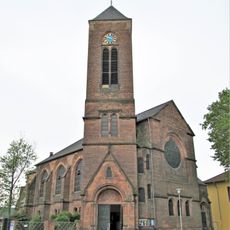
St. Eligius, Gothic Revival parish church in Saarland, Germany.
St. Eligius is a neo-Gothic hall church on Bergstraße in Saarbrücken-Burbach, built 1868–73 to a design by Carl Friedrich Müller. It has a west tower with an octagonal spire, a four-bay nave, a transept and a five-sided choir. The exterior is sparsely decorated; only the transept gables carry pointed-arch friezes and finials.
Built in two phases between 1868 and 1873 by Saarlouis architect Carl Friedrich Müller, with local supervision by Hugo Dihm, the church's foundation stone was laid on 23 May 1869. Construction was interrupted by the Franco-Prussian War, and Dihm had to rebuild the bell frame after constructing it incorrectly. Completed in summer 1873, it could not be consecrated until 28 October 1874 because the Kulturkampf prevented the Bishop of Trier from appointing a priest; the parish was finally established on 8 May 1885.
The parish is dedicated to Saint Eligius, patron of metalworkers and miners, whose feast day is 1 December, reflecting Burbach's mining and smelting past. In 1892 the Katholisches Vereinshaus Burbach opened as a meeting place for the parish's workers', young men's, young women's and rosary associations, which upheld the community's confessional and social identity.
The church stands on Bergstraße in Burbach, north-to-south along the tower, nave, transept and five-sided choir. Since April 2014 a public garden has lain just south of the church, next to the new parish hall, giving visitors a place to sit before or after looking inside.
The tower's octagonal spire rests on a bell storey set back behind a parapet with corner pinnacles. During construction, site manager Hugo Dihm built the bell frame incorrectly and it had to be rebuilt, a detail recorded in the parish history.
The community of curious travelers
AroundUs brings together thousands of curated places, local tips, and hidden gems, enriched daily by 92,717 contributors worldwide.