Adelssitz, Town hall in Bad Kissingen, Germany
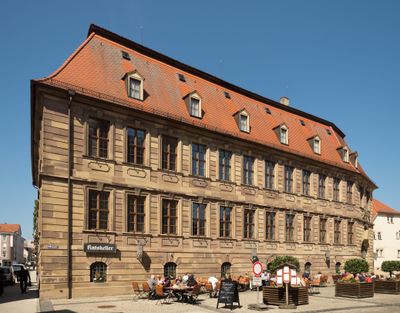
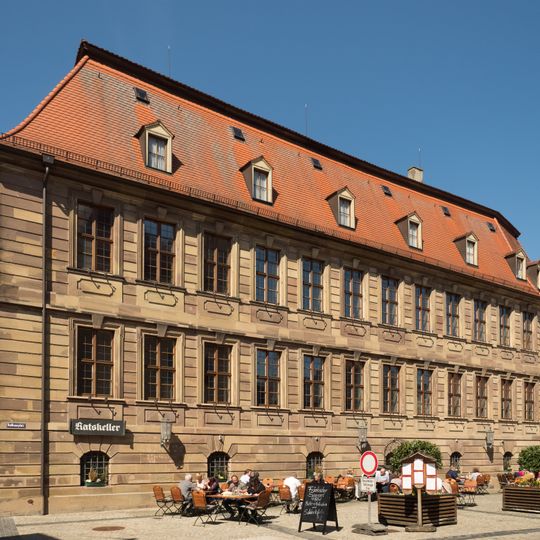
The Neues Rathaus, formerly the Heußleinsches Schloss, is a four-storey stone building with a steep orange-red tiled roof and six dormer windows. Its light brown facade has horizontal banding and rows of white-framed windows; a black sign reading "Ratskeller" marks the ground floor. Johann Dientzenhofer built it in the 18th century for the Heußlein von Eußenheim family.
A 1590 "Schlettensche Kemenate" built by Christoph von Schletten and Maria von Erthal stood here until 1634, when it passed to the Heußlein von Eußenheim family. In 1707 Heinrich Christoph Heußlein commissioned Johann Dientzenhofer to build a new palace on the site. The city bought it in 1928 and has used it as the Neues Rathaus since 1929.
The building is known as the Neues Rathaus, but its earlier name, Heußleinscher Hof or Heußleinsches Schloss, recalls the Heußlein von Eußenheim family, who owned it from 1634. A stone tablet at the gate passage records the 1590 Schlettensche Kemenate that stood here before. Since 1929 the former noble residence has housed the town administration; a Stolperstein in front of the building commemorates Otto Goldstein, removed from the city council in April 1933.
The building stands at Rathausplatz 1, on the paved square where the Ratskeller sign marks the ground floor; the former castle cellar has housed a wine restaurant since 1920. A Stolperstein for Otto Goldstein lies in front of the town hall. The neighbouring buildings at Rathausplatz 2 and 4 were added as auxiliary offices in 1962 and 1976.
A Stolperstein in front of the building commemorates Otto Goldstein, a Jewish city councillor expelled from the Stadtrat in April 1933, who took his own life that August. The stone is easy to overlook on the way to the Ratskeller entrance.
The community of curious travelers
AroundUs brings together thousands of curated places, local tips, and hidden gems, enriched daily by 92,681 contributors worldwide.