Menhiranlage von Darmstadt, Stone circle near Scheftheimer Wiesen, Germany
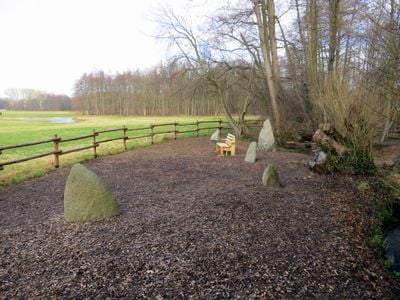
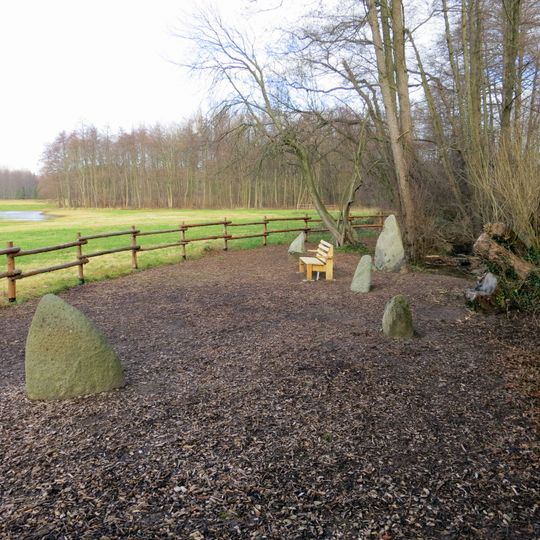
The Menhiranlage von Darmstadt, also called "Hirtenwiese", is a group of 14 upright stones of granite porphyry on the Hirtenwiese at the southern end of the Scheftheimer Wiesen, north of the B26. The stones stand on dark wood-chip ground among low flat stones, with a slatted wooden bench between two of them and a low post-and-rail fence behind.
The 14 granite porphyry stones at the Roßdorf municipal boundary were found in 1966/1967 by local historian Heinrich Gunkel, who identified them as a Neolithic stone circle. Nearby settlement traces of the Rössener culture and the Iron Age place the site in a long-used landscape. In 1993 the Scheftheimer Wiesen nature reserve was designated, and since February 2011 a bridge over the Ruthsenbach and a new access allow entry without a permit.
The site lies at the southern end of the Scheftheimer Wiesen, a meadow area that became a nature reserve in 1993; the stones stand at the edge of the Hirtenwiese, which gives the site its name. The nearby Ruthsenbach bridge, built in February 2011, now carries visitors to the stones. Settlement traces of the Neolithic Rössen culture and the Iron Age were found in the surrounding area.
The site is easy to reach on foot and features an information board explaining the stones. It remains open to visitors at all times since it is freely accessible and requires no special preparations.
The 14 stones are granite porphyry, not the Muschelkalk sandstone sometimes cited. Local historian Heinrich Gunkel found them in 1966/1967 at the Roßdorf boundary and identified them as a Neolithic stone circle. The site lies at the southern end of the Scheftheimer Wiesen, a nature reserve since 1993.
The community of curious travelers
AroundUs brings together thousands of curated places, local tips, and hidden gems, enriched daily by 93,735 contributors worldwide.