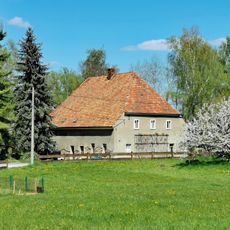
Teufelsstein, Archaeological site in Pließkowitz, Malschwitz, Germany
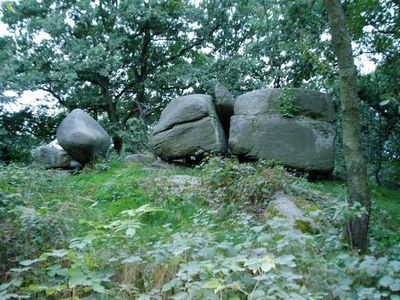
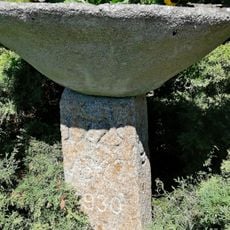
The Teufelsstein, Sorbian Čertowy kamjeń, is a granite rock on a low rise at about 175 m above sea level beside a quarry between Pließkowitz and Kleinbautzen. A slab wedged upright in the central cleft once lay across the rock as a lintel, forming a gate; a second slab with basin-like hollows rests on the ground.
In 1690 Martin Grünwald, vice-rector of the Bautzen Gymnasium, reported remains of pagan altars around Bautzen linked to the god Czorneboh. In 1797 Pastor Pannach of Malschwitz called the rock an "altar of idolatry" and noted signs of deliberate alteration. Excavations by Richard Needon found pottery and stone-age artefacts and concluded the rock had been reshaped into a megalithic, dolmen-like monument.
The name Teufelsstein, Sorbian Čertowy kamjeń, means "Devil's Stone"; one legend calls the rock the Devil's seat. Pastor Pannach of Malschwitz called it an "altar of idolatry" in 1797, and Karl Benjamin Preusker drew it as a pagan sacrificial altar. Since 2008 the Sohland observatory's archaeoastronomy group has studied it as a "sun sanctuary of Upper Lusatia".
The granite rock lies on a low rise at about 175 m, beside a quarry on the road between Pließkowitz and Kleinbautzen. The quarry operator fenced the stone in 2018, but the Malschwitz municipality had the "Betreten verboten" signs removed, citing the forest law that allows access for recreation. The central cleft frames the equinox sun at sunrise and sunset.
In 2023, a plaster cast taken by the Sohland/Spree observatory's archaeoastronomy group proved that the slab wedged upright in the central cleft fits a hollow on the fallen second slab, so the two once formed a gateway. The hollows called the Devil's seats are the old bearing points.
The community of curious travelers
AroundUs brings together thousands of curated places, local tips, and hidden gems, enriched daily by 92,963 contributors worldwide.