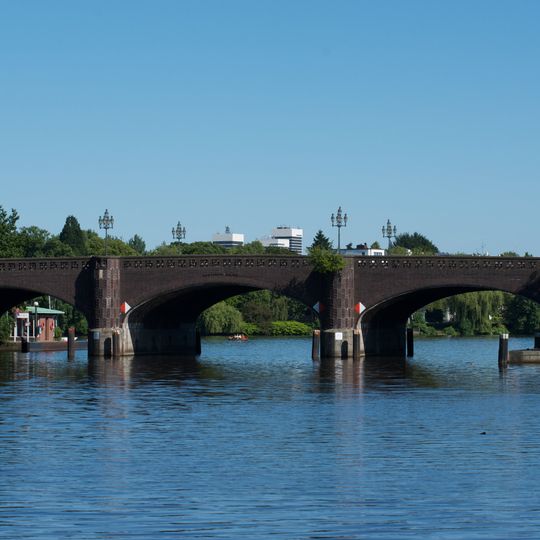
Krugkoppelbrücke, Road bridge in Hamburg, Germany
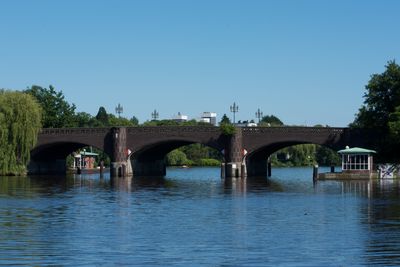
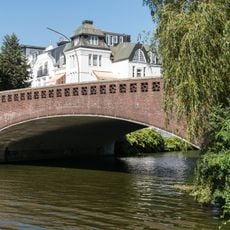
The Krugkoppelbrücke is a 72-metre road bridge spanning the Alster between Harvestehude and Winterhude, built in 1927–1928 to designs by Fritz Schumacher and Gustav Leo. It rests on three fixed basket-handle arches of reinforced concrete, faced with clinker ceramics and terracotta showing vine tendrils and two-tailed sea creatures.
A first permanent wooden bridge was built here in 1891 to plans by Franz Andreas Meyer, one of Hamburg's last timber bridges. The present 72-metre structure dates from 1927–1928 and was designed by Fritz Schumacher with Gustav Leo, using three fixed elliptical-arch vaults of reinforced concrete. It was restored from January 2018 to November 2019 for about 5 million euros, with 41,000 bricks fired anew.
The bridge is probably named after the "Krug Koppel" inn built on the western Alster bank in the 16th century; the name was also used for a path, mentioned in a Hamburg newspaper advertisement of 7 October 1833. Each direction has its own landing stage for Alster steamers.
The bridge carries the Krugkoppel road between Harvestehude and Winterhude, with a landing stage for Alster steamers on each side of the crossing. It is open to cars, bicycles and pedestrians; in 2013 it handled about 13,000 vehicles per weekday, roughly one percent of them heavy traffic.
The bridge is probably named after the "Krug Koppel" inn, built on the western bank of the Alster in the 16th century; Krugkoppel was also the name of a path, mentioned in a Hamburg newspaper advertisement of 7 October 1833. In 2013 the bridge carried about 13,000 vehicles per weekday, roughly 1 percent of them heavy traffic.
The community of curious travelers
AroundUs brings together thousands of curated places, local tips, and hidden gems, enriched daily by 93,094 contributors worldwide.