Pankratiuskapelle, Protestant chapel in Giessen, Germany
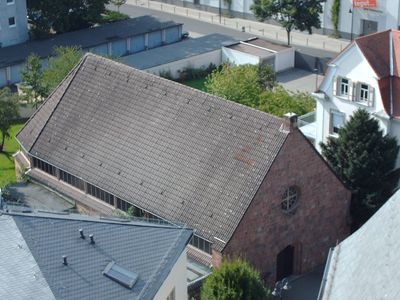
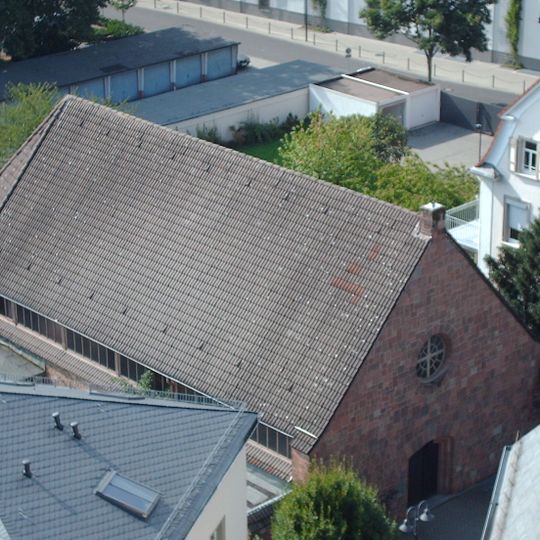
Pankratiuskapelle is a single-nave emergency church built in 1949 to Otto Bartning's Type B design, measuring 25 metres long, 11.5 metres wide and about 11 metres high, with roughly 500 seats. Its southwest end closes in a polygonal five-eighth apse for the altar, and the timber truss construction is largely in its original state. The photograph shows the steep pitched roof of grey-brown rectangular tiles, a gable of reddish-brown stone blocks with a traceried round window and a dark arched doorway, and a lower roof slope over a wall of rectangular windows.
A chapel dedicated to Saint Pankratius and Mary stood in Giessen from the 13th century, first mentioned in 1248; its Gothic successor was called the parish church in 1334. After demolition in 1809 a Neoclassical town church was built from 1810 to 1821. That church burned out in the bombing of 6 December 1944, and its ruins were reused for the emergency chapel, consecrated on 2 October 1949.
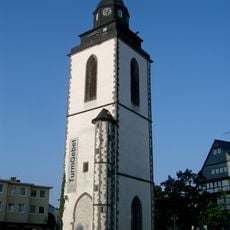
The name Pankratius recalls the medieval town church dedicated to Saint Pankratius and Mary, first mentioned in 1248. Since 2004 the Matthäus and Markus congregations have formed the Evangelische Pankratiusgemeinde, which sees itself committed to the social concerns of Georg Schlosser, its first pastor from 1893 to 1915. The late Gothic tower of the town church, destroyed in 1944, belongs to the congregation and serves it as a bell tower.
The chapel stands about 80 metres west of the late-Gothic tower of the destroyed Stadtkirche, which serves the congregation as its bell tower. The building was set back 5 metres from the street line after a dispute between Otto Bartning and the city building office, which had demanded 10 metres. The site is the former parish garden of the Matthäusgemeinde, not the old church plot.
The chapel is a "Type B" Bartning emergency church, one of 43 built across Germany with funding from the World Council of Churches; a $10,000 donation from the Evangelical and Reformed Church of St. Louis made the Giessen one possible. Congregants did the foundation and masonry infill themselves under the motto "Hilfe zur Selbsthilfe", while the timber frame, doors and windows arrived as prefabricated, donated parts.
The community of curious travelers
AroundUs brings together thousands of curated places, local tips, and hidden gems, enriched daily by 93,654 contributors worldwide.