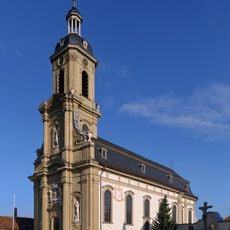
Schloss Wiesentheid, Baroque castle in Wiesentheid, Germany
Schloss Wiesentheid is a symmetrical stone structure from the baroque period with ornately designed facades and grand entrance gates. The building stands centrally in town and impresses with its harmonious proportions and carefully planned architectural layout.
The castle's history starts in the late Middle Ages, when the Counts of Castell held a moated castle in Wiesentheid. In 1547 Count Konrad zu Castell sold it to Valentin Fuchs von Dornheim; his successor Hans Fuchs von Dornheim had the Fuchs-Bau built in 1576. After 1673 the estate passed by marriage to Johann Otto von Dernbach, who granted Wiesentheid market rights in 1682, and then to the Schönborn family in 1704. Rudolf Franz Erwein von Schönborn had the present castle rebuilt from 1711 to 1720 under the direction of Father Nikolaus Loyson.
The castle chapel, once a ball-game hall, was converted in 1765 and holds a Baroque altar by Johann Georg Neßtfell, flanked by two late-Gothic figures of Saint Barbara and Anna selbdritt. Church vessels and vestments have survived there. The Spiegelsaal in the north wing retains its Rococo fittings from around 1730.
The castle stands in the centre of Wiesentheid, and the park north of the four-winged complex is largely open to the public. The residence itself is still lived in by the counts of Schönborn, so the interior is not freely accessible. The Schlossberg between castle and church was levelled in 1846, which is why the two now stand so close together.
The oldest part, the three-storey Fuchs-Bau in the south-west corner, predates the baroque wings by over a century and carries a Renaissance volute gable. Its name recalls the knights Fuchs von Dornheim, who built it in 1576 and lived here until the line died out in 1673.
The community of curious travelers
AroundUs brings together thousands of curated places, local tips, and hidden gems, enriched daily by 92,657 contributors worldwide.