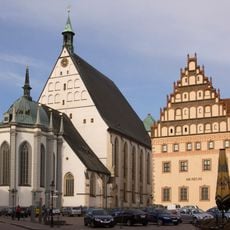
Stadt- und Bergbaumuseum, Mining history museum in Freiberg, Germany
The Stadt- und Bergbaumuseum occupies the late Gothic former Domherrenhof at Am Dom 1, a corner building erected after the 1484 city fire and documented by 1488. A six-sided stair tower raised in 1588 adjoins the south facade, whose ground floor keeps late Gothic curtain-arch windows with interlacing mullions. Inside, cell vaults and carved wooden ceilings survive.
The Freiberger Altertumsverein was founded in 1860 under printer Heinrich Gerlach and opened its collection in 1861 in the Kastenstube of the Kaufhaus at Obermarkt 16. In 1903 the society moved into the renovated Domherrenhof at Untermarkt, inaugurated on 7 May 1903 as the König-Albert-Museum in the presence of King Georg of Saxony. On 1 January 1939 the museum passed into municipal ownership and took the name Stadt- und Bergbaumuseum.
The building was the dean's residence of the cathedral chapter of the Marienkirche, raised to a collegiate foundation in 1480; after the Reformation the town handed it to the Latin school in 1542. The museum's name comes from its 1939 transfer to municipal ownership, when it was called Stadt- und Bergbaumuseum to state its two themes. Its photo library holds glass negatives by the photographer Reymann showing miners at work and in daily life.
The museum is located at Am Dom 1 in Freiberg and is easily reached on foot. Visitors should note that renovation work is underway to implement new exhibition concepts, so current opening times should be checked before visiting.
The museum's photo library holds glass negatives by the photographer Reymann showing Freiberg's buildings and street views, plus rare images of miners' everyday life and working processes. The graphic collection preserves the graphic estate of Johann Christian Klengel and the painted estate of Hugo Koerber.
The community of curious travelers
AroundUs brings together thousands of curated places, local tips, and hidden gems, enriched daily by 92,796 contributors worldwide.