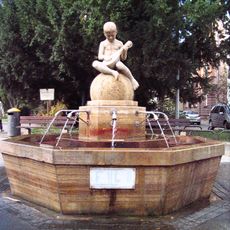
Kurpark, Public park in Stuttgart-Bad Cannstatt, Germany
Kurpark in Stuttgart-Bad Cannstatt is a public park with sunbathing areas, winding paths, and playgrounds distributed across multiple landscaped sections featuring varied vegetation and water features. The layout creates different zones for relaxation and activity throughout the grounds.
In 1819 a straw-roofed pavilion was built over the Wilhelmsquelle spring, which still feeds the Cannstatt brine baths. A double row of promenade trees followed in 1821, linking the spring to the Wilhelmsbad hotel and forming today's Lower Kurpark. Nikolaus von Thouret designed the Kursaal from 1825, completed in 1835 with funds from King Wilhelm I, whose equestrian statue has stood in front of it since 1881. The Upper Kurpark was laid out on the slope above and finished in 1915.
The Gottlieb-Daimler-Gedächtnisstätte occupies the former garden house of the Daimler villa, integrated into the park in 1974; only foundation walls of the villa remain. In the Daimlergarten stands a former shelter of the first motorized tram, which ran between the Kursaal and Wilhelmsplatz.
The park is open 24 hours daily and can be entered through multiple access points. Public transportation at Mergentheimerstrasse station provides convenient arrival for those without a car.
The Lautenschläger Fountain in the lower park was created in 1934 by sculptor Jakob Clement. The Juno Fountain nearby was donated in 1910 by Emil Kiemlen to mark Cannstatt's incorporation into Stuttgart.
The community of curious travelers
AroundUs brings together thousands of curated places, local tips, and hidden gems, enriched daily by 94,645 contributors worldwide.