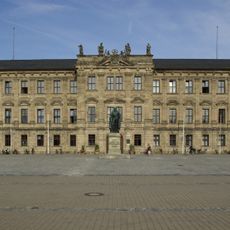
Orangerie, Baroque orangerie in Erlangen, Germany
The Orangerie is a Baroque building in Erlangen with a semi-oval layout, pavilions at each end, and a central rectangular water hall. The three-arched portal on the south side serves as the main entrance to this structure.
Margrave Christian Ernst gave Schloss Erlangen to his wife Elisabeth Sophie in 1703. She commissioned the Orangerie between 1704 and 1706 as part of the palace complex, combining a greenhouse with living quarters and a festival hall. In 1818 it passed to Friedrich-Alexander-Universität and has housed faculties and offices since, including the church music institute and art history seminar from 1914.
The south-facing wall displays sculptures representing the four seasons through Roman gods Flora, Ceres, Bacchus, and Vulcan. These figures give the space a mythological quality that visitors notice when entering.
The main entrance is the three-arched portal on the south facade, framed by paired columns and topped by a broken segmental pediment; the north facade has three plain doors between Doric pilasters. The building is single-storey, and the water hall occupies the rectangular centre between the curved wings.
During the 2009-2012 renovation, workers discovered original shell-shaped water basins embedded in the floor. These finds revealed the water features that once defined the building's function.
The community of curious travelers
AroundUs brings together thousands of curated places, local tips, and hidden gems, enriched daily by 94,150 contributors worldwide.