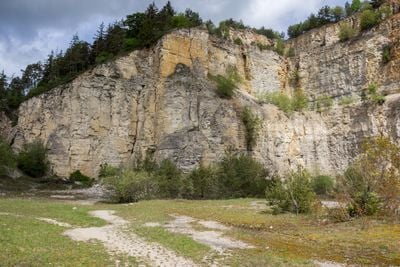
Steinbruch bei Kottingwörth, Historical quarry in Beilngries, Germany.
The Steinbruch bei Kottingwörth is a former limestone quarry with dimensions of roughly 200 meters and rock walls rising to about 70 meters high. The pit displays multiple stone layers that reveal the geological history of this landscape.
The quarry developed through systematic limestone extraction that ran from 1938 to 1975, supplying material for road construction projects. After extraction ended, the site became recognized as a significant geological location and gained protection as one of Bavaria's important geotopes.
The quarry's limestone layers form the type section of the Arzberg Formation, a reference geologists use to identify the same rock sequence across the Franconian Alb from the Nördlinger Ries to Regensburg and the Franconian Switzerland. The two thicker marl horizons, the Platynota and Crussoliensis marls, are where most ammonites and belemnites were found.
The site is accessible via marked hiking trails from Kottingwörth, Beilngries, or Töging, with parking areas nearby for easy arrival. Exploring on foot works best to view the rock formations from different angles and distances.
The rock walls contain hundreds of limestone layers documenting over 5 million years of marine development from the Upper Jurassic period. These visible strata allow visitors to see deep time and understand how ancient seas shaped the region's geology.
The community of curious travelers
AroundUs brings together thousands of curated places, local tips, and hidden gems, enriched daily by 93,674 contributors worldwide.