Liobakirche, church building in Tauberbischofsheim, Germany
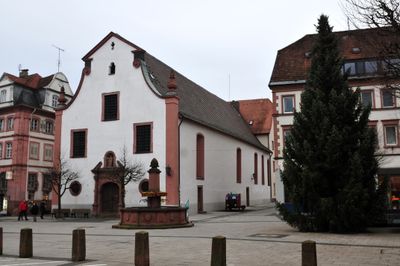
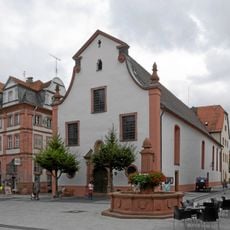
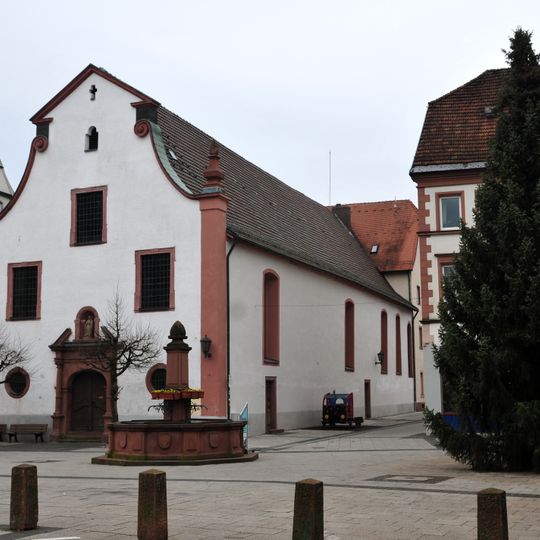
The Liobakirche is a white church with a tall gabled facade topped by a dark tiled roof and a small cross at its curved peak. Two small windows sit above a larger rectangular window, and two square windows flank an arched entrance framed in reddish stone. A reddish stone fountain with a central pillar stands in front.
The church was built in 1650 as the Elisabethkapelle and became the monastery church of the Franciscans, founded in Tauberbischofsheim in 1629. The Franciscans moved the entrance to the market side. The monastery was dissolved in 1823, and the last friar, Eucharius Greulich, died in 1832. The building was later used by the Gymnasium and as a storage depot during World War II.
The church is named after Saint Lioba, an English missionary whom Saint Boniface appointed as the first abbess of the Benedictine convent in Tauberbischofsheim. In 2005, during the town's 1250th anniversary, Archbishop Robert Zollitsch formally declared her patron saint of the city. Inside, a display case holds relics and works of Lioba, including manuscripts of songs and plays, as well as exhibits from the Congregation of the Benedictine Sisters of Saint Lioba in India.
The church stands on the market side of Tauberbischofsheim, its entrance moved there by the Franciscans to give the building more prominence. The facade faces a reddish stone fountain with a central pillar, and a reddish building stands adjacent. Visitors enter through the arched doorway framed in reddish stone.
During restoration work in 1968, old graves were discovered beneath the church floor, likely belonging to important figures from the past. This discovery shows that the site has been a center for burials and worship for over a thousand years.
The community of curious travelers
AroundUs brings together thousands of curated places, local tips, and hidden gems, enriched daily by 94,454 contributors worldwide.