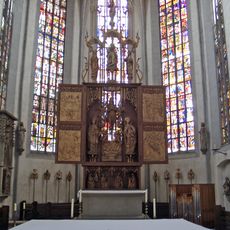
Münnerstädter altar, Gothic altar in Münnerstadt, Germany.
The Münnerstadt altar is a 15-meter-high carved wooden retable that Tilman Riemenschneider made between 1490 and 1492 for the high altar of St. Maria Magdalena in Münnerstadt. Its central shrine shows Mary Magdalene raised by six angels, flanked by St. Elisabeth of Thuringia and St. Kilian; the predella holds the four Evangelists, and the wings carry four reliefs of her legend. The figures are not painted but coated with pigmented glue size.
Tilman Riemenschneider received the commission on 26 June 1490 from the Münnerstadt council and church wardens for 145 guilders, and the retable was installed in autumn 1492. In 1504 Veit Stoss, who had fled to Münnerstadt after forging a promissory note, was paid 220 guilders to paint and gild it and added four panels of the Gailana conspiracy. The altar was dismantled in 1649/53; originals are now in Berlin and Munich.
The altar's name comes from Mary Magdalene, to whom the church is dedicated. In the central shrine she is shown naked, covered only by her long hair, as six angels lift her over a desert landscape while a seventh holds a crown above her; the type draws on the legend of Mary of Egypt. The four Evangelists sit in the predella below, not around the central scene.
The altar is located inside the parish church and can be viewed during regular church hours. It is worth taking time to examine the carving from different distances, as details appear differently depending on where you stand in front of it.
The carving was finished with a special pigmented glue technique instead of traditional paint, with only certain details like stars and mouths receiving added color. This unusual approach gives the work a distinctive appearance quite different from conventionally painted wooden sculptures.
The community of curious travelers
AroundUs brings together thousands of curated places, local tips, and hidden gems, enriched daily by 92,787 contributors worldwide.