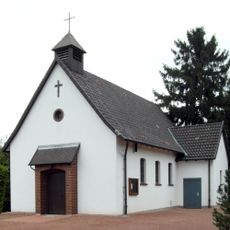
Michaeliskirche, Lutheran church in Ronnenberg, Germany.
The Michaeliskirche is a Romanesque basilica built from 1150 to 1160 by craftsmen of the Königslutter building school, with three naves, a transept and a bell tower on a square plan. Sandstone and partly ashlar masonry support the round-arched vaults; the crossing, the eastern apses and the tower's lower section keep their 12th-century fabric. Inside, a pointed arch with two round pillars painted in red-and-white chevrons opens onto the chancel, where three stained-glass lancet windows stand behind a gilded altarpiece.
Built from 1150 to 1160 by craftsmen of the Königslutter building school, the basilica replaced an older Boniface chapel first documented in 1078. That chapel was demolished in 1660 for structural decay, and its three-granite-slab portal was moved into the tower hall in 1983. The choir was extended in 1464, as the keystone date shows.
The late-Gothic altarpiece, carved around 1500 before the Reformation, shows Jesus and the crowned Mary seated side by side on one bench, equal in size. Superintendent Hermann de Boer called the pair a point of contact for ecumenism, especially for miners who came to Ronnenberg's potash works from mostly Catholic Silesia.
The building is accessible to visitors during specific hours when the office staff is present. It is worth inquiring beforehand or checking the door, as visiting windows are limited and irregular.
The Bonifatiusportal, a three-piece granite relief, was moved into the tower hall in 1983 to protect it from weathering; its lintel shows the Lamb of God in a mandorla flanked by doves and two dragons. The octagonal font dates from the 17th century; on 13 November 1800 the Jewish physician Israel Stieglitz was baptised here as Johann, a step that let him become court physician in Hanover in 1802.
The community of curious travelers
AroundUs brings together thousands of curated places, local tips, and hidden gems, enriched daily by 92,719 contributors worldwide.