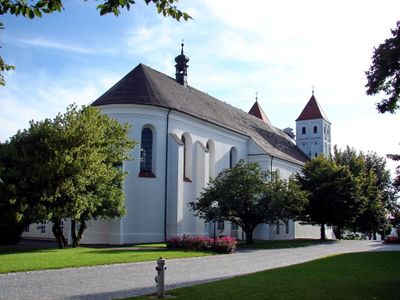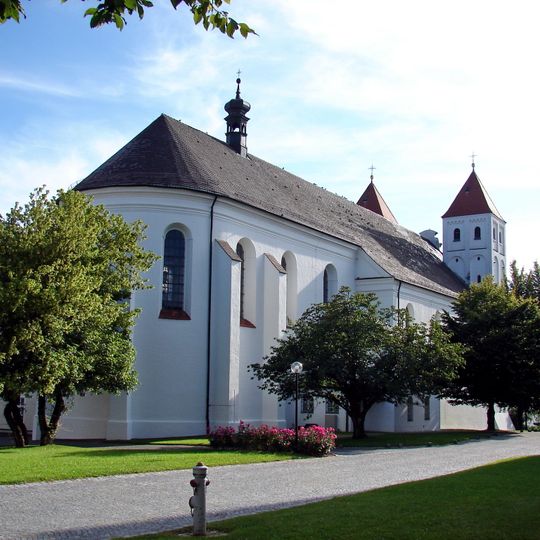
St. Johannes, Abbey church in Mallersdorf-Pfaffenberg, Germany.
St. Johannes is a white abbey church on a hill above the Kleine Laber valley, entered through a late Romanesque west portal of limestone with a three-stepped, columned jamb and a tympanum bearing a cross with lilies and rosettes. Two five-storey square towers with pyramid roofs flank a Baroque centrepiece crowned by a figure of the church patron; the interior is a south German wall-pillar hall.
A first church, the so-called Old Münster, is said by late medieval tradition to have been consecrated in 1109, two years after the Benedictine monastery was founded; it stood west of today's church and was demolished in 1759. The present site held a 12th-century building consecrated in 1177, rebuilt in late Romanesque style and re-consecrated in 1265 as a three-aisled basilica without transept, whose double-tower front and west portal survive. The late Gothic choir followed in 1460–1463, the conversion into a wall-pillar church from 1613, and the Rococo remodelling begun in 1740 under Abbot Heinrich VI Widmann, consecrated only in 1792 under Abbot Gregor Schwab.
The church is dedicated to St. John the Evangelist, whose statue crowns the baroque gable between the two west towers. Since 1869 the Poor Franciscan Sisters of the Holy Family have used it as their convent church, and since 1921 it has also served as the parish church for Mallersdorf, Ettersdorf, Ried and Seethal.
The church stands at 411 m on the monastery hill, about 30 m above the Kleine Laber valley, within the Mallersdorf abbey complex. The west front faces Klosterbergstrasse, where the two five-storey towers with pyramid roofs mark the entrance; the late Romanesque west portal sits in the baroque porch between them. Inside, a wrought-iron grille of around 1720 separates the entrance hall from the nave.
The west portal, moved into a Baroque porch after 1740, is a late Romanesque work in limestone from the church consecrated in 1265, with a three-stepped jamb of three-quarter columns and a tympanum bearing an isosceles cross with lilies and rosettes. Its style is linked to the portal of St. Jakob in Regensburg, carved around 1200.
The community of curious travelers
AroundUs brings together thousands of curated places, local tips, and hidden gems, enriched daily by 92,751 contributors worldwide.