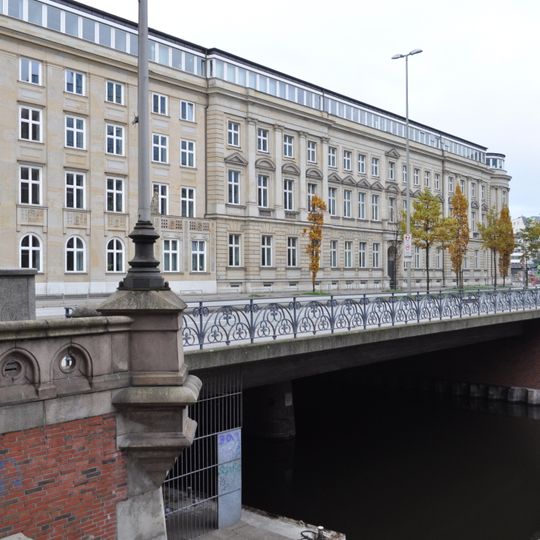
Stadthausbrücke, Road bridge in Neustadt, Hamburg, Germany
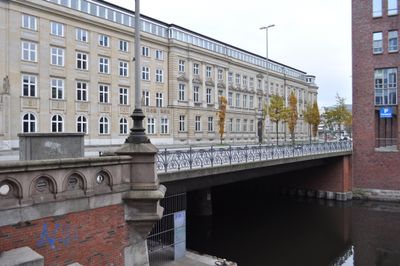
The Stadthausbrücke is a road bridge in Hamburg's Neustadt district, completed in 1889, carrying the street of the same name over the Bleichenfleet. The fleet is visible only on the western side of the bridge. Its grey stone parapet is topped by a black metal railing with circular scrollwork panels, and a stone pier with a black lamp post stands at the bridge end.
The Stadthausbrücke was completed in 1889, replacing earlier crossings between Hamburg's Altstadt and Neustadt. It spans the Bleichenfleet, which is visible only on the western side of the bridge. The bridge gave its name to the roughly 230-metre street S581 running from Neuer Wall to Axel-Springer-Platz; buildings 4, 8, 10 and 12 are listed as cultural monuments.
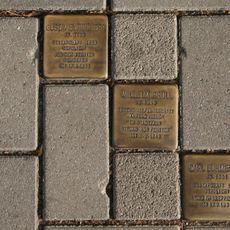
The bridge is named after the Stadthaus on its east side, the building it faces. In front of Stadthausbrücke 8, Stolpersteine commemorate the communist resistance fighters Carl Burmester and Gustav Schönherr and Wilhelm Prull, a homosexual victim of the Nazi regime. The street of the same name runs about 230 metres from Neuer Wall to Axel-Springer-Platz, and buildings 4, 8, 10 and 12 are listed as cultural monuments.
The bridge is in central Hamburg and can be reached on foot from the S-Bahn station of the same name in just a few minutes. Sidewalks run on both sides of the roadway, so pedestrians can cross the fleet comfortably.
The S-Bahn station of the same name opened on 1 June 1975 with the partial opening of the City-S-Bahn line between Hauptbahnhof and Landungsbrücken. Part of it lies beneath the Bleichenfleet and the Alsterfleet, where the ceiling is slightly lowered so ships keep enough water depth in the canal.
The community of curious travelers
AroundUs brings together thousands of curated places, local tips, and hidden gems, enriched daily by 92,775 contributors worldwide.