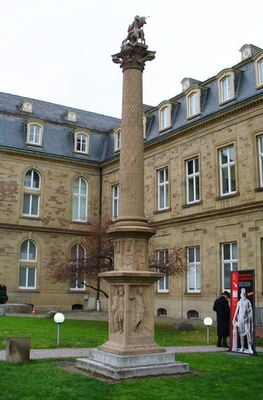
Jupitergigantensäule, Roman Jupiter column in Hausen an der Zaber, Brackenheim, Germany
The Jupiter Column of Hausen an der Zaber is a Roman votive monument over seven meters tall, made of reed sandstone. It rises from a four-gods stone with reliefs, through an eight-sided week-gods stone, to a fluted shaft covered in stylized oak leaves and acorns. The capital bears busts of the four seasons, and the top shows Jupiter riding down a giant.
The column was erected around 200 CE by the estate owner Gaius Vettius Connougus, a Roman citizen of probably Celtic origin, as a votive offering to Jupiter and Juno, likely in thanks for his harvests. In 1964, excavation recovered the almost completely preserved remains, which were brought to the Roman Lapidarium in Stuttgart. Casts of the reconstructed column were set up in Hausen, Stuttgart, Köngen and Güglingen.
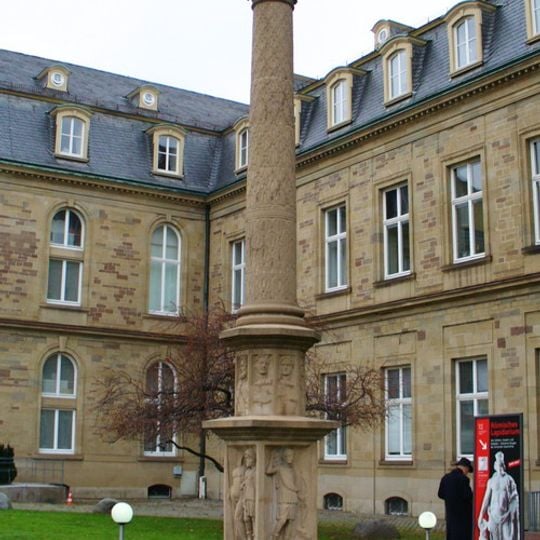
The oak-leaf scales covering the shaft, with acorns growing from their base, point to the Celtic tree cult that fed into these columns; the wreath in the Four Gods relief carries the same motif. The donor, Gaius Vettius Connougus, bore a Celtic name, and the dedication to Jupiter and Juno was made on his own estate.
The cast of the reconstructed column stands in Hausen an der Zaber, in front of the Römisches Lapidarium in Stuttgart, where the red sign "Römische Götterwelten" marks the display. The original fragments, recovered in 1964, are kept in the Stuttgart lapidarium collection. Further casts were set up in Stuttgart, Köngen and Güglingen.
The column shaft is covered in stylised oak leaves with acorns, hanging downwards above a narrow band and pointing upwards below it. This oak decoration sets the Hausen column apart from others, which carry simple scale patterns, vine motifs or figure reliefs, and points to the Celtic tree cult behind the monument.
The community of curious travelers
AroundUs brings together thousands of curated places, local tips, and hidden gems, enriched daily by 94,070 contributors worldwide.