Wallfahrtskirche Maria Heimsuchung Klausen, Catholic pilgrimage church in Klausen, Germany.
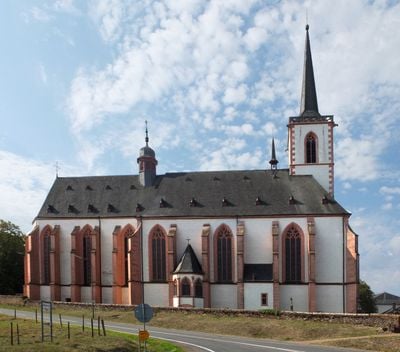
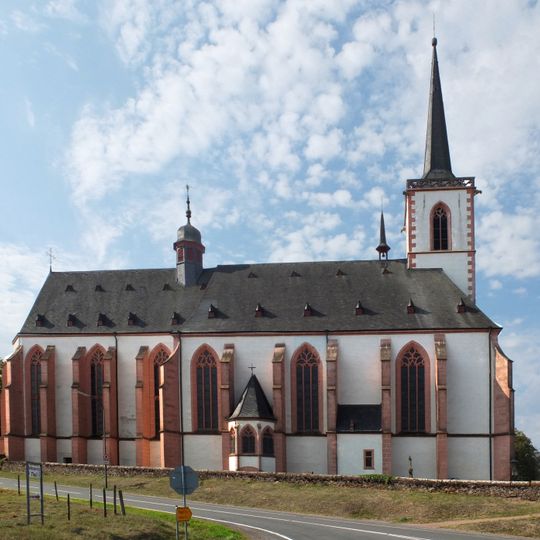
Wallfahrtskirche Maria Heimsuchung Klausen is a Catholic place of worship built in Gothic style with pointed arches, ribbed vaults, and vertical stone elements that rise upward. The structure displays typical features of medieval church architecture with its elongated windows and proportioned layout.
In 1440 the day labourer Eberhard placed a small Marian figure in a hollow tree; after a vision he built a hermitage there in 1442, and healings drew pilgrims. In 1456 Archbishop Jakob von Sierck founded a Windesheim Augustinian canonry, probably advised by Nicholas of Cusa. The canons built the late Gothic church with donations from the knights of Esch and pilgrims: choir finished 1474, sacristy and library 1491, consecrated 1502. Secularised in 1802, it became a parish church.
The church is also called Eberhardsklausen after the day labourer Eberhard, who set a small wooden Madonna in a hollow tree around 1440. Pilgrims still buy Klausener Zuckerpfeifen, sugar-stick sweets, as a souvenir, and the old 20 cm oak Pietà is kept in the Gnadenkapelle beside the tower.
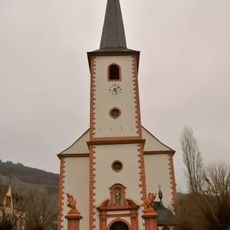
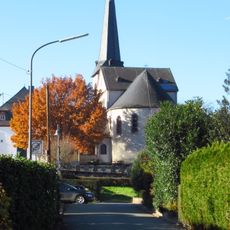
The church is oriented unusually toward the southeast, perhaps because of Eberhard's original hermitage; the square tower with its pointed spire closes the northwest end, and the Gnadenkapelle continues the side aisle beside it. The nave and choir are of equal width under net vaults, so the interior reads as one long hall. Look for the two grave slabs in the southern annex, one showing the knight Gotthard von Esch, who died in 1465.
A wine barrel, the Eberhardsfässchen, is built into the tip of the tower spire, recalling a local legend. Pilgrims also take home Klausen sugar pipes (Klausener Zuckerpfeifen) as souvenirs, and the church receives over 100,000 pilgrims each year.
The community of curious travelers
AroundUs brings together thousands of curated places, local tips, and hidden gems, enriched daily by 94,045 contributors worldwide.