Wasserburg Turow, Medieval water castle in Glewitz, Germany
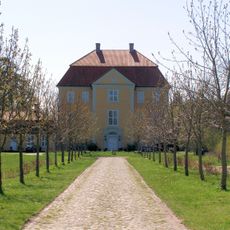
Wasserburg Turow is a medieval water castle in Glewitz consisting of a main castle structure and an adjoining manor farm. The complex sits within landscaped grounds featuring lakes and streams that form the historic moat system around the buildings.
The site began as a probably Slavic motte of the 12th century, later built up by monks of Neuenkamp Monastery, who erected a defensive tower with walls about 1.50 m thick. Turow was first documented in 1387, when Henrikus Lüssow held it. The Bonow family owned it from 1414 to 1636 and carried out the building expansions; in the 15th century the castle was enlarged into a water castle with moat and outer rampart.
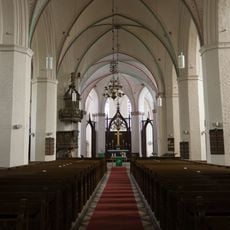
The so-called Blue Hall was used as a chapel from 1900. It has a cross vault resting on a single central column, and its walls carry painted canvas wallpapers from 1820 showing arcadian landscapes. The castle also has a small inner courtyard closed off by a gate.
The complex is reached via Turow in the municipality of Glewitz, in the Vorpommern-Rügen district. Two bridges cross the remaining moats, and the water still surrounds about two thirds of the site. The park paths follow the relocated moat, now shaped as English-style park lakes and streams, so sturdy shoes help on the round walk.
The castle's tower survives in its core, and the walls are still about 1.50 m thick. The Blue Hall, used as a chapel since 1900, has a cross vault resting on a single central column and painted canvas wallpapers from 1820 showing Arcadian landscapes.
The community of curious travelers
AroundUs brings together thousands of curated places, local tips, and hidden gems, enriched daily by 94,311 contributors worldwide.