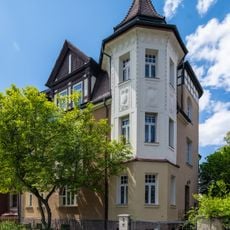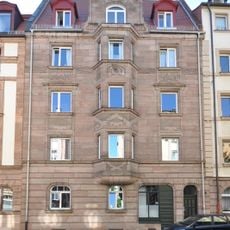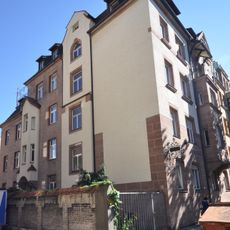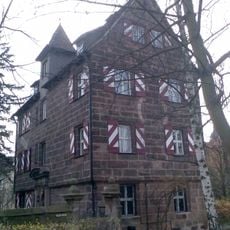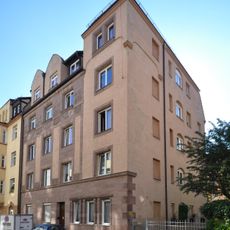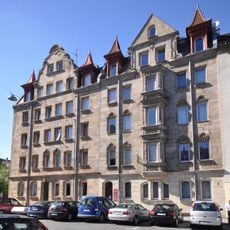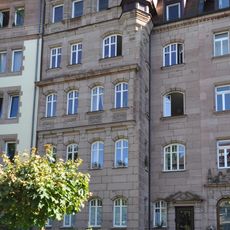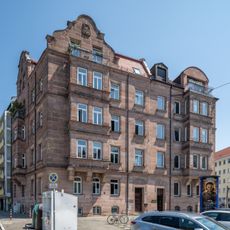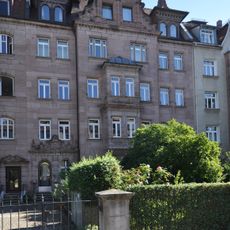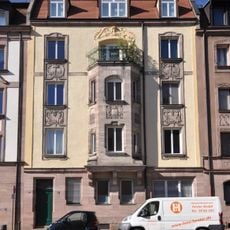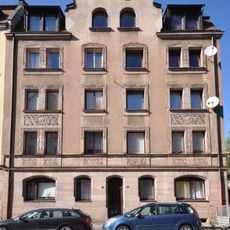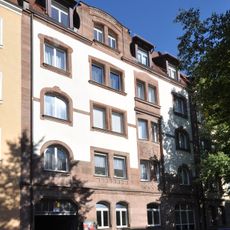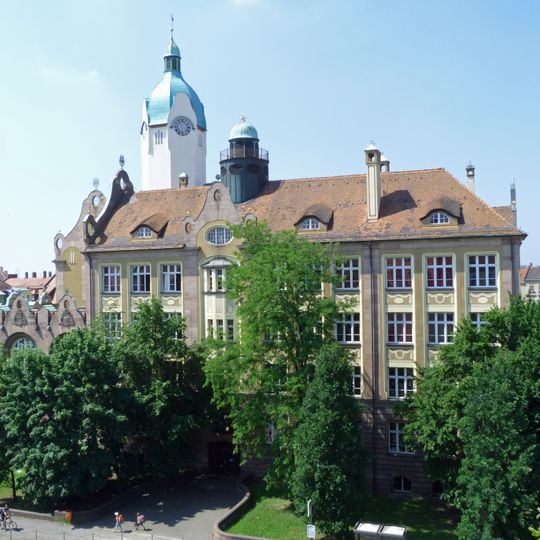
Bismarckschule, Educational architectural monument in Nuremberg, Germany.
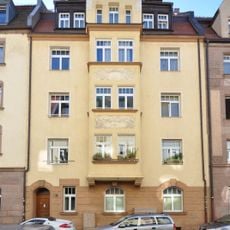
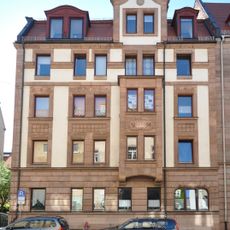
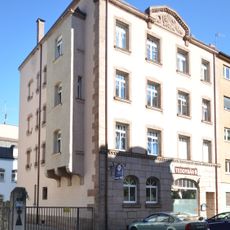
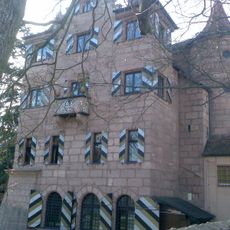
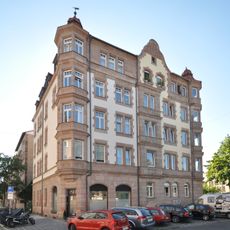
Bismarckschule is a listed school complex in Nuremberg's Schoppershof district, built 1902–1904 in Jugendstil style to plans by Georg Kuch and Carl Weber. Two four-storey wings at right angles, one for boys and one for girls, are joined by a block holding the assembly hall and gymnasium. A 47-metre octagonal clock tower rises above the red Burgsandstein building, whose facades carry stucco and sgraffiti ornament.
A village school for Schoppershof was built on the site in 1879; by 1881 it taught 244 pupils in three classes. After Schoppershof was incorporated into Nuremberg in 1899 the building was too small, so a new Jugendstil school by Georg Kuch and Carl Weber was erected beside it in 1902–1904. In 1945 shelling damaged the new building and destroyed the old schoolhouse; the US Army occupied the school, and lessons resumed in October 1945 in shifts.
The school is named after Otto von Bismarck, who had died a few years before construction began in 1902. Its most famous pupil was the writer Hermann Kesten, enrolled in 1906 and attending until 1910. The building's decoration carries school subjects and moral tales: reliefs of globe, gymnastic rings and owl on the east side, and Struwwelpeter and Getreuer Eckart reliefs above the former boys' and girls' entrances.
The building is located in a central residential area of Nuremberg and is easily reachable on foot. Since it functions as an active school, it is best viewed from the outside or visited during special events and guided tours.
The octagonal clock tower rises 47 metres and served as a landmark for the whole Schoppershof district. Look for the winged toads at the roof corners and the fish-shaped gargoyle that once fed a fountain on the wall.
The community of curious travelers
AroundUs brings together thousands of curated places, local tips, and hidden gems, enriched daily by 94,627 contributors worldwide.