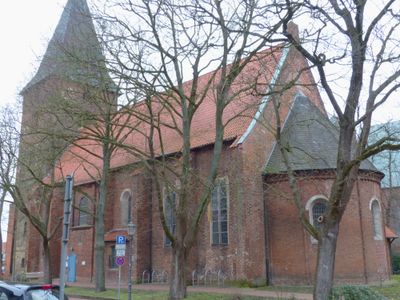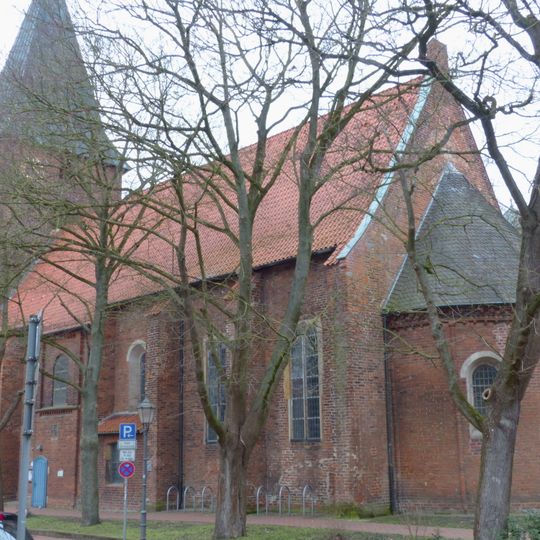
St. Andreas, Lutheran church in Verden, Germany
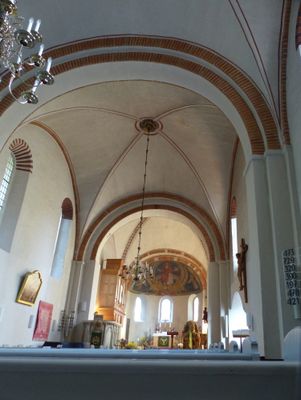
St. Andreas is a single-nave late Romanesque brick church with a choir and a sandstone tower to the west, built in the first quarter of the 13th century. Its three nave bays carry round-arched cross-ribbed vaults, the apse a semi-dome, and the exterior longitudinal walls have buttresses. The tower was raised by two storeys in the late Gothic period.
A first church of natural stone, possibly the bishop's private chapel, stood here around the year 1000. The present late Romanesque brick building with its sandstone west tower was erected in the first quarter of the 13th century for a collegiate foundation of canons established by Bishop Iso in 1220. In the late Gothic period the tower gained two storeys and a sacristy was added to the north side.
The church is named after the Apostle Andrew. Its 1649 baptismal font was donated by a Swedish officer, and the medieval painting above the altar showing Christ with the four Evangelists was only found during modern renovation work. The oldest of the three tower bells dates from the 13th century; the others were cast in 1958 and 2021.
St. Andreas stands just south of Verden Cathedral, so approach on foot through the cathedral square; the sandstone west tower is the landmark to aim for. The nave is entered from the west side, and the raised south windows of the late Gothic period are best seen from outside along the southern wall.
The oldest of the three bells in the tower dates from the 13th century; the other two were cast in 1958 and 2021. The organ, built in 1981 by the Hanover firm Emil Hammer, has 13 stops on two manuals and pedal, plus a tremulant acting on the whole instrument and a Cymbelstern.
The community of curious travelers
AroundUs brings together thousands of curated places, local tips, and hidden gems, enriched daily by 94,553 contributors worldwide.