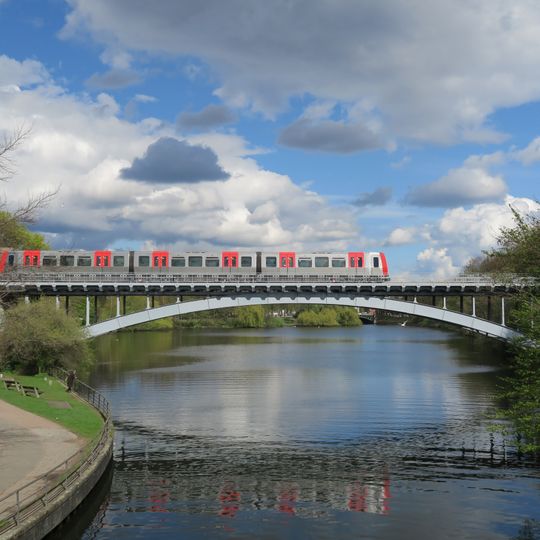
Kuhmühlenteichbrücke, Railway bridge and cultural heritage monument in Hamburg, Germany
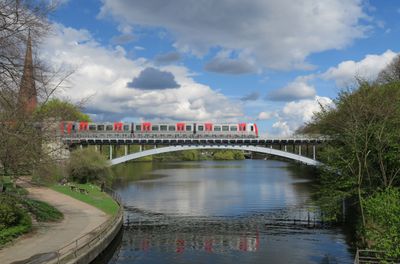
Kuhmühlenteichbrücke is a 55-metre-span iron arch bridge carrying the Hamburg U-Bahn Ring line over the western end of the Kuhmühlenteich, linking Uhlenhorst and Hohenfelde. Its granite-clad abutments are carved with reliefs of the four elements and matching animals.
The bridge was built in 1911/12 to designs by Ludwig Raabe and Otto Wöhlecke, the Hochbahn's house architects before World War I. A planned multi-pier bridge was replaced by a filigree iron arch with a 55-metre span because of the landscape by the Kuhmühlenteich. It was finished a month before the U-Bahn opening run between Rathaus and Barmbek on 15 February 1912.
The bridge is often called the most beautiful of Hamburg's elevated railway bridges because of its shape, the decorated abutments and its setting beside the Kuhmühlenteich. Its granite abutments carry reliefs of the four elements, each paired with matching animals: for water, a man catching rain and a woman filling a jug, with fish below.
The bridge is best viewed from the surrounding paths and parks where you get a clear view of the structure from different angles. To explore the area comfortably, aim for daytime hours when there is good natural light.
The outward faces of the four granite-clad abutments each carry a relief of one of the four elements, with matching animals in the band below: for water, a man catching rain and a woman filling a jug, with fish beneath. The bridge was finished a month before the first U-Bahn run from Rathaus to Barmbek on 15 February 1912.
The community of curious travelers
AroundUs brings together thousands of curated places, local tips, and hidden gems, enriched daily by 93,325 contributors worldwide.