Schloss Wachau, Baroque château in Wachau, Saxony, Germany
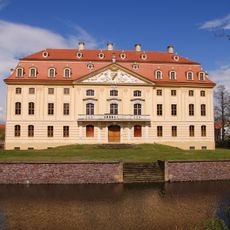
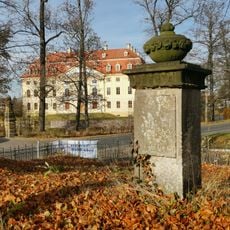
Schloss Wachau is a symmetrical, horseshoe-shaped Baroque palace on a rectangular island of about 3,400 square metres, encircled by a moat, in Wachau in Saxony. The two-storey building with a mezzanine and high mansard roof has its entrance side facing south, where a three-axis central risalit carries a triangular gable with the von Schönfeld coat of arms and curved balconies. The side wings face the rear courtyard, and the restored facade painting, windows and striped base recall the work of Johann Christoph Knöffel.
The château was built in 1730 and represents the architectural development of noble residences during the Saxon Baroque period. It emerged in an era when wealthy families of the region sought to display their power and prosperity through grand buildings.
The château displays the architectural tastes and social position of 18th-century Saxon nobility through its formal design and layout. Its rooms and gardens reflect how the upper classes of that era lived and their preference for ordered, symmetrical spaces.
The château stands on a rectangular island of about 3,400 square metres encircled by a water-filled moat, reached from the south side. The English park with its sandstone Commedia dell'arte sculptures lies south of the building. The park was restored in 2018 so that the original planting and path layout is visible again.
The architect of the palace is unknown, but its ground plan, roof, dormers and windows recall Barockschloss Rammenau, while the facade painting, windows and striped base resemble Barockschloss Zabeltitz, both built in the 1720s by Johann Christoph Knöffel. The interior also holds a Moorish Room modelled on Andalusian Mudéjar architecture and a Dutch Kitchen tiled with Dutch tiles from around 1750.
The community of curious travelers
AroundUs brings together thousands of curated places, local tips, and hidden gems, enriched daily by 92,641 contributors worldwide.