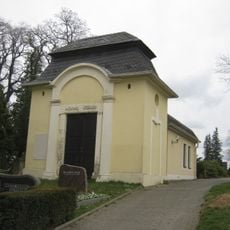
Agra, Park and cultural monument in Markkleeberg and Leipzig, Germany
The agra covers 190 hectares south of Leipzig, split between the exhibition centre and the landscaped agra-Park. The exhibition centre has three T-shaped halls (5,518, 4,750 and 3,000 square metres; there is no Hall 3) with a vestibule and forum between them. The park, designed from Paul Herfurth's 19th-century landscape park, mixes meadows, ponds, groves and monuments, including the 1897 White House and the 1672 Dölitz gatehouse.
Paul Herfurth purchased land in Raschwitz in the late 1800s to build a summer residence with a manor house and park designed in the English style. The property was later transformed into a venue for exhibitions and cultural activities.
The park holds the Deutsches Fotomuseum and a collection of tin figures, housed in buildings within the grounds. The site's name comes from the agricultural and horticultural fair "agra", held here for over fifty years from 1948; in 1969 alone it drew 750,000 visitors. Today the grounds host the Wave-Gotik-Treffen and, each October, a reenactment of the Battle of Leipzig.
The exhibition center is reached from Bornaische Straße, with about 2,500 parking spaces; the B 2 crosses the site on an elevated road. Tram line 11 stops at the main entrance, and S-Bahn lines S5/S5X, S6 and S4 (peak) serve Markkleeberg and Markkleeberg-Nord. Bus 108 circles the site hourly.
The watermill on the Mühlpleiße stream is one of the monuments in the landscaped park, alongside the Dölitz gatehouse of 1672 and the White House of 1897, the former Herfurth villa. The park also holds the German Photo Museum.
The community of curious travelers
AroundUs brings together thousands of curated places, local tips, and hidden gems, enriched daily by 94,524 contributors worldwide.