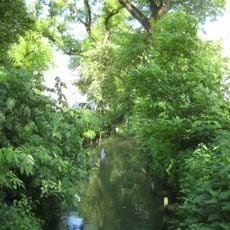
Flutmulde Landshut, Flood discharge canal in Landshut, Germany.
The Flutmulde Landshut is a flood discharge canal that stretches from the western side of the city toward the main railway station in a northeastern direction through residential and urban areas. The structure features wide walls and a deep channel designed to move large volumes of water quickly during periods of heavy rainfall or flooding.
Built between 1948 and 1955, the Flutmulde was dug as a left-bank relief channel so that Isar floodwater could bypass Landshut's centre. Its inflow is not controlled by a weir: once the river reaches the equivalent of 3.00 m at the Birket gauge, up to 400 m³/s diverts into the channel. The Pfettrach originally ran through it in a canal-like bed; between 1986 and 2001 its course there was renaturalised in sections and now meanders.
The Pfettrach, which enters the channel near Löschenbrand, ran in a canal-like bed when the Flutmulde was built; between 1986 and 2001 its course was renaturalised in sections, so it now meanders through the channel. The inflow is not controlled by a weir: once the Isar reaches 3.00 m at the Birket gauge, up to 400 m³/s diverts into the channel.
The canal is best viewed from the banks or from bridges that cross over it, which offer good views of the construction. The best time to visit is during normal water levels, when the full structure is clearly visible and accessible for observation.
The Pfettrach stream crosses under the Flutmulde at Münchnerau, creating an intricate hydraulic interaction between the water systems.
The community of curious travelers
AroundUs brings together thousands of curated places, local tips, and hidden gems, enriched daily by 94,027 contributors worldwide.