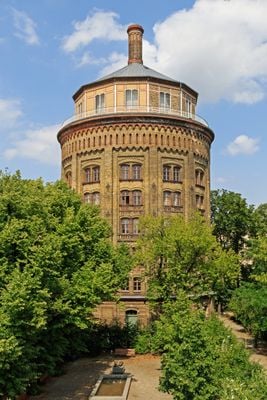
Wasserturm Prenzlauer Berg, Water tower in Prenzlauer Berg, Berlin, Germany
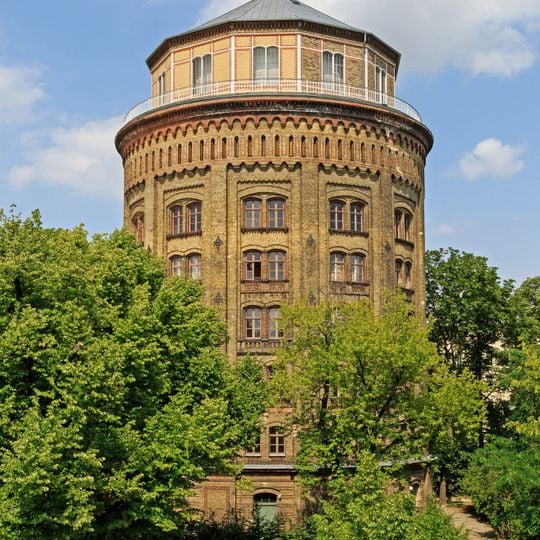
Wasserturm Prenzlauer Berg is a seven-storey brick tower with a 24-metre outer diameter, clad in clinker brick and topped by a broad ornamental frieze and a shallow conical roof. Round-arched windows sit in continuous segmental recesses on each floor. The top floor held the water tank; the six floors below contained workshops, offices and the machinery operators' flats, which are still used as housing.
The site's waterworks began in 1856, when the Berlin Waterworks Company under Thomas Russell Crampton and Charles Fox built an open 3,000 m³ reservoir and a standpipe tower on the Windmühlenberg. After the city bought the facilities in 1874, it added a lifting station and engine houses, then erected the six-storey water tower, completed in 1877. The tank was raised seven metres in 1907 and its volume reduced to 835 m³; the tower operated until 1952.
Locals call the tower "Fat Hermann" (Dicker Hermann), a nickname earned by its broad cylindrical form. The six floors beneath the water tank once housed the machinery operators' apartments; these are still inhabited and much sought after. The tower appeared on Prenzlauer Berg's coat of arms from 1920 to 1987 and again from 1987 to 1992.
The building can be viewed from the outside and is easily reached by public transportation, with the neighborhood inviting leisurely walks. Visitors should plan time to stroll through the surrounding area to fully appreciate the industrial character of the district.
The tower is nicknamed "Fat Hermann" (Dicker Hermann) by locals. Its six lower floors once held the machinery operators' flats, which are still lived in and much sought after. From 1920 to 1987 and again from 1987 to 1992 the tower appeared on the district coat of arms.
The community of curious travelers
AroundUs brings together thousands of curated places, local tips, and hidden gems, enriched daily by 92,724 contributors worldwide.