Dorfkirche Redekin, Romanesque brick village church in Jerichow, Germany
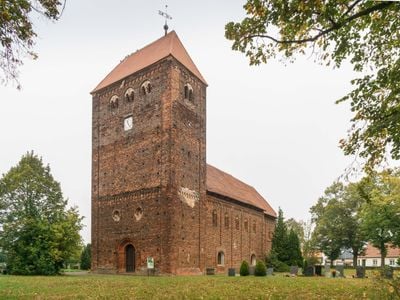
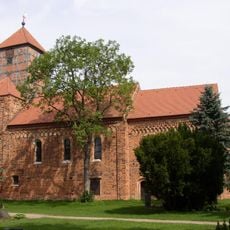
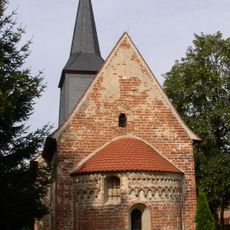
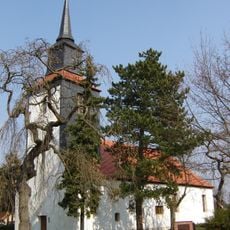
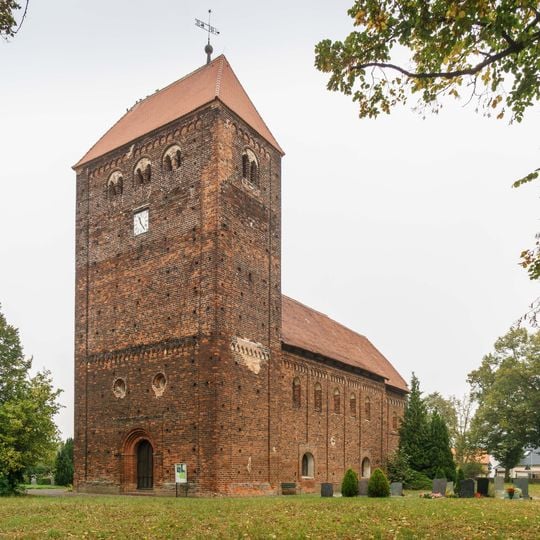
Dorfkirche Redekin is a four-part Romanesque brick church: a flat-roofed nave, an inset choir with cross vault and semicircular apse, and a wider rectangular west structure from around 1200. Its reddish-brown brick walls are divided by pilasters, a German band and round and cross arch friezes; the choir's south wall carries scratched sundials. The west tower has a stepped round-arch portal with two oculi above and a steep red-tiled pyramidal roof with a weather vane.
Built around 1200, the church follows the model of Jerichow Monastery and is closely related to the village churches of St. Marien and Willebrord, though it is a hall church rather than a basilica. Its walls are articulated with pilasters, a German band and round and cross arch friezes, with pointed arch friezes on the nave. The bricked-up round-arched portals on the nave remain, while the high windows keep their original form.
The late Gothic carved altar from the second half of the 15th century shows a Madonna between adoring angels and four saints in two rows. Its crowning crucifix has a corpus from around 1230, older than the shrine itself. The font keeps a Romanesque bowl on a shaft reworked in 1908.
Visitors should be prepared for uneven ground and tight spaces typical of medieval buildings when exploring the site. For guided tours in German or English, it is best to contact the local parish office in Jerichow beforehand.
The church serves as a burial site for historical figures from the region, including members of the von Alvensleben family and an 18th-century actress. This connection to theater history makes the site particularly interesting for those curious about cultural ties to the performing arts.
The community of curious travelers
AroundUs brings together thousands of curated places, local tips, and hidden gems, enriched daily by 93,132 contributors worldwide.