Pappelallee Cemetery, Cemetery and cultural heritage monument in Pankow, Germany.
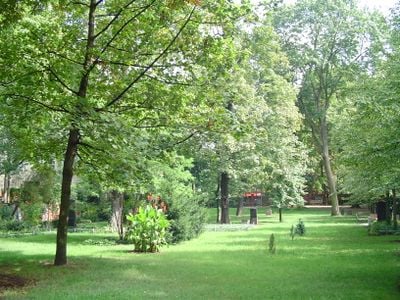
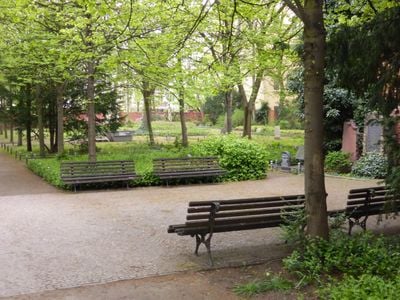
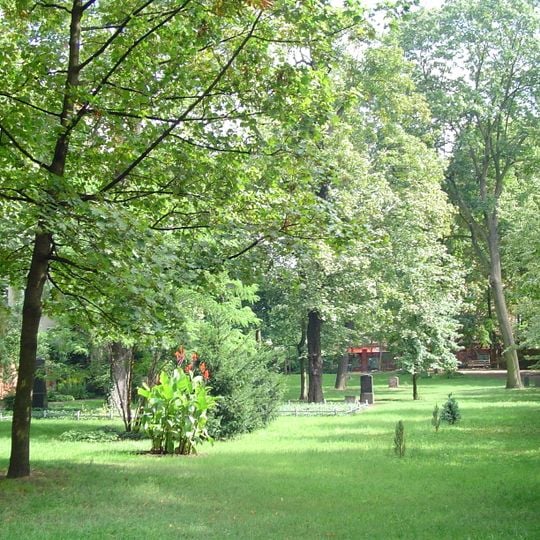
Pappelallee Cemetery is a closed burial ground turned public park in Prenzlauer Berg, between Pappelallee and Lychener Straße. Scattered dark upright grave markers, some with rounded tops, stand among low ground cover and bare earth, with wooden slat benches on metal frames facing the graves. A low hedge, slender tree trunks and a pale wall border the site.
The Freireligiöse Gemeinde, founded in Berlin in 1845 as the Deutsch-katholische Gemeinde by dissidents who left the Roman Catholic Church, opened its burial ground in 1848 on about 6,000 m² between Pappelallee and Lychener Straße, land given two years earlier by landowner Wilhelm Griebenow. From 1893 only members were buried here. The Nazis dissolved the community in 1934 and nationalised the cemetery in 1936; burials continued until 1969 and the cemetery closed in 1970.
The cemetery gate bears the inscription "Die Berliner Freireligiöse Gemeinde...", recalling the free-religious congregation that founded the burial ground. Graves of Social Democratic deputies Wilhelm Hasenclever and Theodor Metzner, journalist Johann Baptist von Hofstetten and stenography inventor Heinrich Roller remain; a plaque on the wall commemorates veterinarian Friedrich-Ludwig Urban, a barricade fighter of 1848.
The cemetery is open to the public with well-maintained paved pathways that are easy to navigate. Visitors can also find green spaces and a play area, making the site accessible for different uses.
The site received the Gustav-Meyer-Prize in 1995 for successfully combining historical graves with modern park use. This recognition honored how the cemetery serves as both a memorial space and a functional green area.
The community of curious travelers
AroundUs brings together thousands of curated places, local tips, and hidden gems, enriched daily by 92,765 contributors worldwide.