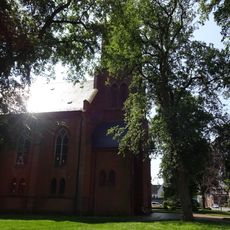
St. Bartholomäus, Lutheran church in Brake, Germany.
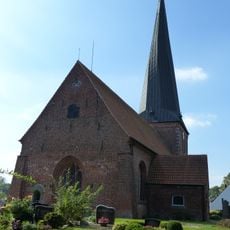
St. Bartholomäuskirche is a church building in Golzwarden with red brick walls, a steep gabled roof, and an octagonal roof turret. It combines late Romanesque hall church design with a Gothic polygonal choir that was added later.
A church at Golzwarden was first documented on 6 December 1263, when it became an independent parish separated from the mother church at Rodenkirchen and was dedicated to the Apostle Bartholomew. The 13th-century brick hall church on a two-metre-high churchyard mound ended in a late Romanesque apse. A fire layer supports the Hamelmann chronicle's report that the village and church burned in 1375 under Conrad II of Oldenburg; the foundations were rebuilt in the 14th century. The fortified west tower, called the strongest tower in Friesland, was demolished in the 15th century after Bremen captured Stadland in 1414 and besieged the church; the archbishop of Bremen ordered its defences removed. The apse was replaced by a Gothic polygonal choir in the 15th century, and the west tower was finally taken down in 1514, its material used for a free-standing bell tower.
The parish is named after the Apostle Bartholomew, to whom the church was dedicated when it became independent of the Rodenkirchen mother church on 6 December 1263. Inside, a 1663 bell by the Bremen founder Claudi Gage hangs in the roof turret, while the separate bell tower holds a 1440 bell by Ghert Klinghe, cast for St. Nikolai in Edewecht, looted in 1538 and sold to Golzwarden.
The church stands on a two-metre-high churchyard mound at the northern edge of Golzwarden, with the separate bell tower about 10 metres west of the nave. The south portal, once probably the main entrance, is sheltered by a vault; the north portal is walled up. The west gable is rendered, unlike the rest of the brickwork. After the roof fire of 4 July 2019, repairs ran from 2020 to 2023 and the church was reconsecrated on 1 October 2023.
The building has an independent bell tower positioned about 10 meters west of the nave, constructed in 1514. This separate tower was built using materials from the original west tower, showing a practical solution from that era.
The community of curious travelers
AroundUs brings together thousands of curated places, local tips, and hidden gems, enriched daily by 92,644 contributors worldwide.