Castle Hinterglauchau, Medieval château in Glauchau, Germany
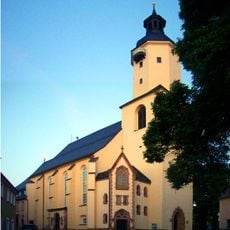
Schloss Hinterglauchau is a Renaissance castle on the western spur of the Schlossberg in Glauchau, built from 1470 on the site of a castle founded around 1170. The photograph shows a large white-plastered building with a steep red-tiled roof, a gabled section with dark-framed windows on the left, and a slender central tower topped by a dark bulbous cupola. To the right, an arched entrance painted in red and white diagonal stripes is flanked by windows, next to a gabled section with a rounded top and a small green roof. A museum has occupied the castle since the early 20th century.
The Lords of Schönburg built the original fortress here in the late 12th century. Around 300 years later, the structure was transformed into a livable palace and took on its current appearance.
The name Hinterglauchau only became usual after 1900; until the mid-19th century the building was simply called the "hinteres Schloss", while the newer part built from 1527 to 1534 was the "förderes Schloß". A museum has occupied the castle since the early 20th century. Visitors reach the courtyard only by crossing a stone bridge over the neck ditch from Schloss Forderglauchau.
Schloss Hinterglauchau sits at the western tip of the Schlossberg and can only be reached through the courtyard of Schloss Forderglauchau, across a stone bridge over the neck ditch. A gate leads from the southern slope into the Berggarten above the Hirschgrund ravine. The steep drop on the south, north and west sides makes the approach from the town side the practical route.
The museum displays works and writings of Georgius Agricola, a scholar who conducted pioneering research in mineralogy and metallurgy. This scientific collection is unexpected for a place primarily connected to local crafts and everyday history.
The community of curious travelers
AroundUs brings together thousands of curated places, local tips, and hidden gems, enriched daily by 93,363 contributors worldwide.