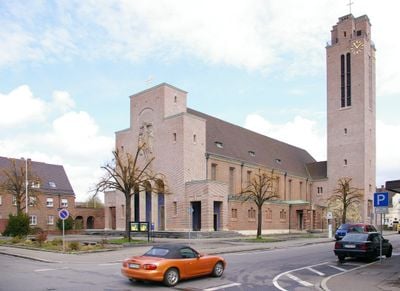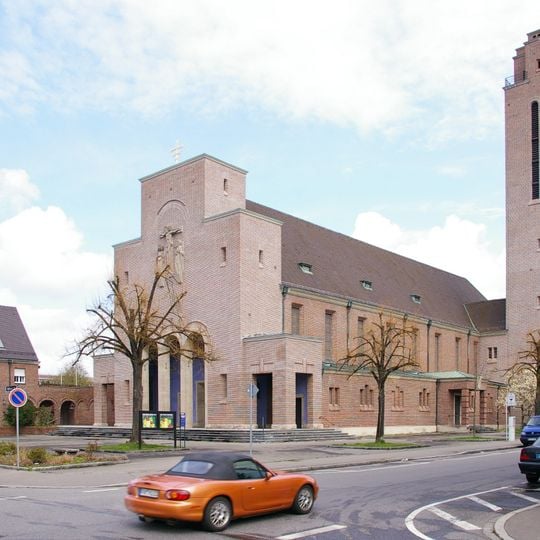
St. Petrus Canisius, Catholic church in Friedrichshafen, Germany.
St. Petrus Canisius is a Catholic parish church on Katharinenstraße in Friedrichshafen, built 1927–1928 to designs by Hugo Schlösser and Wilhelm Friedrich Laur. The geosted brick basilica has a 58 m nave with short, narrow windows, low side aisles, a short two-level choir, and a 46 m tower on the south side. The west facade has three tall Muschelkalk arcades over the entrances, a relief of St. Peter Canisius in the porch, and a monumental Crucifixion group above the arches.
Population growth north of Friedrichshafen in the 1920s led to the separation of a chaplaincy from St. Nikolaus and the construction of this church in 1927–1928 to designs by Hugo Schlösser and Wilhelm Friedrich Laur. Bishop Joannes Baptista Sproll consecrated it on 24 November 1928 under the patronage of St. Peter Canisius, and it became an independent parish church in 1938. A bombing on 28 April 1944 destroyed the parish house but left the church largely intact.
The parish, with 4,800 Catholics in 2018, is the largest in Friedrichshafen. The name honours Petrus Canisius, to whom Bishop Joannes Baptista Sproll entrusted the church at its consecration on 24 November 1928. Inside, the first pointed arch of the nave holds the Löwentaler Heiligenhimmel, a large painting from the former Löwental monastery.
The building is centrally located in Friedrichshafen and is easy to reach by public transport or on foot. Visitors should know that opening times follow worship services, and it is advisable to check in advance for details.
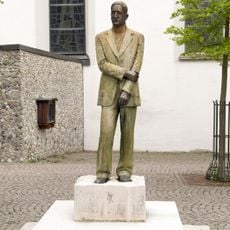
The church's name honors a Jesuit whose theological works shaped Catholic education across Europe. This makes the place a representation of an important historical figure, though many visitors may not immediately realize this connection.
The community of curious travelers
AroundUs brings together thousands of curated places, local tips, and hidden gems, enriched daily by 92,840 contributors worldwide.